Oops!!! With the busy Memorial Day weekend I forgot to write a post. As a cashier the days before a holiday are very busy. On top of that I was preparing for a pulmonary function test which was this morning. I had to go all Memorial Day without my daily and rescue inhalers. I spent my holiday doing as little as possible so I would not have an asthma attack. I went on a binge watching shows on Netflix and my husband took me out for ice cream.
I hope you all had a wonderful Memorial Day and have a wonderful week. I plan to have a new post for you next Tuesday. Remember to keep fighting for recovery and look for the positive things in your life. You’re worth the fight.
Do to struggles with health problems I didn’t write a blog post this week. So here is an old but food one.
Things happen in your life that lifts your spirits and also get you thinking. Life is full of surprises. Sometimes it gives you a bumpy road to travel and other times it gives you smooth roads. We never know what road we will be traveling on. The road to recovery can be like getting rid of an old, rusty car for a shiny, new one. You’re getting rid of an old, broken life for a new, bright life.
Tuesday morning my husband and I sat down to have breakfast. We began to talk about the problems with our 2008 Chevy Cobalt. We needed to get it fixed before May when our inspection would be up. We had a hole in the rocker panel, a sensor needed replacing, and we were having problems with the steering. There was no way we could afford to fix all these problems. We had already replaced the gas line and had the muffler repaired along with other things. It was time for something new.
This got me thinking about myself while I was sick. I was like our old car. I had lots of problems that needed fixing. I was self-injuring, my thoughts were negative, I was suicidal, and I couldn’t control my anxiety attacks. Like our car, I couldn’t afford to keep my life going on that road. I needed to change. I needed to renew my life.
After breakfast my husband and I decided to look at newer cars. We texted a friend we met through the dealer we bought our Cobalt from and she suggested a dealer ship. We drove to a town about a half hour away. We talked to a sales man, and he took us to a cherry red Chevy Equinox. The inside looked like new even though it was used. Both of us fell in love with it right away. We took it for a ride and we wanted to buy it. We were like kids in a toy store. So we began the long process of paperwork.
My choice to work towards recovery was like looking at new cars. I looked at what my life could be like in recovery. I saw a chance for a new, bright life. I was excited to take it for a test drive. I fell in love with the idea I could be happy. Like doing paperwork, I had a long process of therapy, medication, and work before me to reach recovery. I knew it wasn’t an easy process, but I wanted it like we wanted that car. I was willing to do whatever it took to reach recovery.
Hours later we got the keys to the SUV, and we drove to my parents to show it off. For a long while I had gotten used to being chauffeured around by my husband and lost interest in driving. When we got this SUV, I suddenly wanted to drive everywhere. I had a new toy and excitement filled me. At work I told my customers about our new vehicle and showed them pictures. Getting rid of the old car helped me let go of worries and getting a new one filled me with happiness.
Reaching recovery is like getting a new car except instead of a new car, I got a new beginning. I wanted to show everyone the new me. I bragged about my new beginning. I had this new shiny life to show off, and I wanted to tell everyone and I did. I still do. I tell everyone about how I threw away my rusted life and built a new one. I was and am excited. I’m not cured, but I’m happy.
Recovery is as shiny as a new car. Reach for it; strive for it. Get rid of your old broken-down life, and work towards a new one. Recovery is worth the fight. You don’t have to settle for an endless life of darkness and sadness. You can find happiness. You can learn to control, and manage your mental illness. Happiness is waiting for you. Fight for it.
I’m doing well in recovery. I’ve had bumpy roads, but I enjoy the smooth roads. I’m driving down the road in the light of recovery.
I thought it was time to let you know what is going on with my book and my writing. They’re at a slow point, but they’re about to pick up. I put aside setting up talks and book signings for a bit as I struggled with my asthma. My asthma has been out of control, and I have a pulmonary function test and I see a specialist at the end of the month to hopefully get answers. Even though I have been struggling I haven’t given up. I have been busy planning and writing. Here is what I have been up to and what is to come.
Last week I couldn’t write my blog post because of computer problems. I usually write on my couch, using a lap desk with the sound of the TV playing in the background. I sat down to work on a chapter about the years after we sold the garage when my dog, Esther, needed to go out. I sat my lap desk with the computer on it on the couch beside me. My computer slipped off and landed on the floor. The screen went black and refused to turn back on. My screen had blown. I put my frustrations about the loss of my computer on Facebook and a co-worker and friend messaged me she had a laptop for me. I got the new computer last Saturday, so instead of writing a blog post I was setting up all my programs.
When I asked my friend if I could give her something for the computer she said, “You don’t need to give me anything. I know how important your writing is.”
I got a partial scholarship to attend Saint Davids Christian Writers conference. I needed to come up with another $225. Finances have been hard this year. I was ready to decline the scholarship, thinking my husband and I couldn’t come up with the extra amount when my cousin suggested I start a GoFundMe. The next day I started the GoFundMe, and in one day I raised enough money to go to the conference. June 21 to the 25 I will be attending Saint Davids Christian Writers Conference at Allegheny College in Meadville, PA. I am excited to learn new techniques and information about writing. Conferences help us make connections with other writers and with publishers and agents. It also helps us improve our writing careers.
I have been toying with two new ideas for books. My plan for my next book was to write a book compiling my blog posts. My friend Roberta has agreed to organize them for me, but she has been busy. I’m not quite sure where to start that book. So, I decide to wait for Roberta and see what posts she picks out for my book. Last week I decided to start chapter one on the years after the garage. I have nine pages written. I don’t know yet how to end the chapter. In Escape to the Garage: Family Love Overcomes Bullying, the chapters ended with coffee break and adventures at the garage. Now the garage is gone; in the next book I must search my memory for a new ending to my chapters. I plan to get a start on my book using my blogs once I decide how to start it and see what posts Roberta chooses for it.
Wednesday I am talking in the children’s section of Patterson Library in Westfield, NY. It’s about a forty-five drive from my home. I’m excited. My English teacher who helped me enter contests and edited my writing in high school volunteers at that library. I’m hoping she will attend my talk and I will get a chance to thank her for all she did for me. I haven’t seen her since I graduated from high school. I’m also looking forward to talking to children and their parents about bullying. If you live in the area, come see me. It starts at 4 P.M.
I work for a grocery store as a cashier. While girl scouts were selling their cookies at the store, I told the leaders about my book and my advocacy against bullying and handed them a business card. Last month a girl scout leader messaged me on messenger and asked me to speak to her troop. The troop will be girls from first to fifth grade. I also asked the leader to invite the parents. The leader said she’ll pay me twenty-five dollars to speak. I believe it’s very important to tell children of all ages how hurtful bullying is. I will be talking to the troop and their parents on May 24 at 6 P.M.
There will also be some new things happening with the One Life Project where I am director of Education and Research. The leader of the organization has big plans for me. I will let you know soon about what is to come.
I have a lot going on in my life and I’m excited. Following my dreams, advocating against bullying, and starting new adventures keeps me pushing forward in the light of recovery.
When you are struggling with mental illness, you develop bad behaviors that turn into a pattern of bad choices that worsen the illness. We learn to cope in the only way we know how, and without therapy, our techniques can be damaging to us and those around us. Also, while struggling with mental illness, we develop bad thinking patterns that are self-destructive. How do we change these behavioral and thought patterns? The best way to change them is through behavioral therapy.
The first question you may have is what is behavioral therapy? The website healthline, defines behavioral therapy as a form of therapy that looks to identify and help change potentially self-destructive or unhealthy behaviors. It’s based on the idea that all behaviors are learned and that behaviors can be changed. The focus of treatment is often on current problems and how to change them. Behavioral Therapy: Definition, Types & Effectiveness (healthline.com)
A popular form of behavioral therapy is cognitive therapy. This deals with the bad thought patterns you form while you are sick. This type of therapy focuses on how negative thought patterns lead to unhealthy behaviors. Your negative thoughts can lead to poor choices, bad relationships, angry episodes, bad coping techniques, and a lack of interest to live a productive life. If you believe you’re an awful person and you don’t deserve to be treated well, you may fall into bad and abusive relationships.
Through bullying at school, I learned to hate myself, and my thoughts became negative and self-defeating. I couldn’t see anything good about my life, and this led me into a series of abusive relationships. A high school friend abused me in ways I can’t say. I held onto her tightly because I thought I needed her and couldn’t live if I lost another friend. Another friend as an adult stole my paycheck, made false promises, and lied, but I stayed loyal to her. Another friend stabbed me in the back over and over and yet I moved in with her and her husband to only be treated badly. I made poor choices in friends because I felt I was worthless and didn’t deserve better. My thinking pattern ruled my actions.
For a long time, I stopped writing because my thoughts told me I was a failure, I was an awful writer, my dreams were hopeless, and I wasn’t smart enough to write a book. I was stuck with a dream to write a book, but I believed my dream was impossible to complete. So, I put my pen down and my computer away and dwell in self-defeating thoughts. That thinking pattern prevented me from achieving my dreams. After years of being told I was worthless and a failure, those ideas were drilled into my head. With that cognitive distortion I was stuck going nowhere. My dream to write a book faded.
In cognitive behavioral therapy I learned to challenge my thoughts and turn them into positive ones. I began to identify the type of thinking I was using like magnification, disqualifying the positive, jumping to conclusions, and so on. In therapy I learned how to practice self-affirming thoughts, to journal something positive about my day and about myself each day. It’s hard work and takes a lot of time, but it changes your life.
Now I make better choices. I cut off unhealthy relationships; I notice the signs of negative people and I keep my distance. On my road to recovery, I ended a lot of bad relationships. I learned that I deserve healthy and happy friendships, not ones where I end up getting used, abused, and hurt. The friends I have chosen lift me up, support me, and treat me well and I am able to treat them the same way.
Since I have fought the negative thinking about my dream to write a book, I have written and published a book. I have short stories published and I have won several contests. I’m no longer stuck in a world of self-defeat. I no longer feel like a failure. I’ve been on the news and in the newspaper talking about my book. I’m doing talks about bullying and I’m doing book signing. Changing my thought pattern changed my life.
Cognitive behavioral therapy is effective and a big part of your road to recovery. It’s not easy to do. It takes a lot of hard work to change the way you have been thinking for a long time, but it’s worth it. If you have the right therapist, he or she will give you homework and show you ways you can use this type of therapy in your life. Changing your thinking will not cure you of mental illness, but it will lead you down the road of recovery. Your bad thinking will not disappear forever. You’ll find yourself from time to time falling into your old patterns, but you’ll have methods to combat them. Cognitive therapy teaches you healthy coping techniques.
I am happy with the life I live and the accomplishments I have made. By going through cognitive therapy, I have learned coping techniques that help me stay in recovery and keep me above that dark hole. Because of cognitive therapy, I’m thriving in the light of recovery.
The one place we would think we could go and not be judged, put down, or treated badly is church. In the Bible we are taught that everyone is equal. Jesus saw all people as equal, despite their sins or evil ways. Jesus fed the hungry, healed the blind, and made the lame walk. He never put people down and he never turned his back on anyone. We as Christians should do the same especially in God’s house. Unfortunately bullying happens in the one place where it shouldn’t, church.
Bullying happens in many churches especially small churches. I’ve seen it myself. In many churches there seems to be one person who likes to take control of everything. This person seems to have a following. Other church members want to be on her or his good side, so they conform. By doing this they form a pack against those who stand on their own and pass judgment when they don’t have a right to.
This happened to a woman, I’ll call Sally, who means the world to me. I went to a small country church with this Sally. One bossy lady in the church took control of everything. She also had a group of women who followed her. Sally was a homemaker. Sally spent her life dedicated to raising her children and taking care of her home. The bossy lady and her followers judged her for that. They judged her for the way she dressed, the style of her hair, and much more.
Sally wanted to help revive the Sunday school at this church. The bossy lady agreed but insulted or turned down any of Sally’S ideas and plans. Sally would go to church events and be ignored by the others. Being ignored and left out of social events is another form of bullying. The bullying began to drag Sally down, causing her emotional pain; she and her husband ended up leaving the church. This should never happen anywhere and especially at a church.
Church is where we are supposed to be accepted no matter what. It’s not our job to judge anyone no matter how different they are or even if we don’t agree with their lifestyles. God is the ultimate and only judge. Church is the place we should be able to go and be welcomed with opened arms. Our baggage, our sins, our differences, and so on should be left at the door. Inside church we are God’s children loving each other for who we are inside. God loves each of us equally and treats us the same and so we should do the same.
In churches sometimes you hear rumors. I’ve heard it at church myself. Gossip is a form of bullying. It’s telling information about someone without knowing the facts. Rumors destroy lives because they change and grow as they are passed around. Such as “I heard Jessica is cheating on her husband with an old friend,” becomes “Jessica’s child is not her husband’s; it’s the child of the man she slept with behind her husband’s back” and so on. The truth could be that Jessica just had lunch with an old college friend.
Bullying is a big problem in our churches, society, and in our schools. People should never be treated badly for their differences especially at church. At church we gather as sinners, as beautiful unique people, and as God’s children. Love, acceptance, and kindness should be shared with all. No one person should take charge of things in a church. Each person has the right to take part in all church activities. When you go to church, love each person as God loves each one of his children.
God made each of us different. Not one of us is the same. Our uniqueness is what makes us special individuals. Differences are beautiful and not something to judge. In church, at school, in communities, and at work, embrace everyone’s uniqueness and treat everyone the way you want to be treated, with kindness.
Standing up against all bullying and spreading the word about the harm it causes fills me with pride and helps me bathe in the light of recovery.
We can all reach out and help each other through volunteering. Giving a little bit of your time to a cause that means a lot to you strengthens you as a person and helps you help others. There are a lot of organizations that need help, but one that means a lot to me is The One Life Project created by Alexander Kovarovic. This program fights for teens, college students, and young adults who are struggling with mental illness.
One Life Project’s mission statement is: The One Life Project works to build and create a kinder world where we educate, advocate for, and support teens, college students, and young adults who are struggling with mental health in the hopes of preventing suicide in young people and ending the stigma that surrounds mental health.
I volunteered several years ago with another nonprofit Alexander ran. I believe so strongly in Alexander’s missions that I agreed to volunteer with his new nonprofit, One Life Project. The Project’s mission means a lot to me. I use my blog to fight the stigma that surrounds mental illness, to educate others, and to inspire those who struggle with mental illness to fight for recovery. By volunteering for One Life Project, I am taking my advocacy even further to help in an even bigger way.
I am assistant to the director of One Life Project, and I will be dealing with research and education. It is an important position. I will have other volunteers under me who I will direct to do research that will be put on One Life’s website. It’s important that we provide as much information to the public as possible to help educate, guide, and save lives. I can also do some research of my own. I also write for the Project’s blog.
You don’t have to sacrifice hours that you could be working, spending with family, studying for school, and so on to volunteer. I am volunteering on my days off. If you can only give one day a week or a couple hours, your help is valued. Volunteering for One Life Project is your chance to help others learn about mental illness and to help those who are suffering with this awful illness. There are many ways you can volunteer and there are many aspects to this project. To explore the project and to find out about volunteering, go to their site at Inspire Kindness | One Life Project (projectonelife.org).
A lot of issues tie into mental illness such as bullying, dating abuse, sexual abuse, suicide, and more. One Life Project deals with every aspect of mental illness and even the related issues. We put together information to educate, train, and inform society about these topics. One Life Project also arranges events to bring awareness to mental illness. It’s our job as volunteers to reach out and help others. We may be just helping one person at a time or maybe hundreds. We are helping save lives and bring change into our world by volunteering to this nonprofit.
Suicide is a big problem among our teens, college students, and young adults. Young people are taking their lives because they feel there is no other way. They’re struggling and are afraid there is no help for them. By bringing awareness to suicide prevention and mental illness, we can give these younger people a second chance at life. We can show them there are other choices and there is help. How can you turn down this chance? How can you not volunteer for this project?
According to the World Health Organization, “Globally, one in seven 10-19-year-olds experiences a mental disorder, accounting for 13% of the global burden of disease in this age group. Depression, anxiety, and behavioral disorders are among the leading causes of illness and disability among adolescents.” You can find this information at Mental health of adolescents (who.int). That is a lot of young people who need help. Imagine giving a young person a chance to get help and reach recovery.
One Life Projects motto says it all, “Be true, be you, be kind.” The goal is to create a kinder, more understanding, and accepting society for everyone despite their differences. The Project accepts everyone as the special unique individual they are. Please consider volunteering.
We hear quite a bit about children being bullied. It is a big topic in the news and on social media. However, the fight against bullying should stretch beyond the walls of schools because bullying also happens to adults in their workplaces, communities, and even churches. Many children who bully learned how from their parents. They see their parents bully and think it is all right.
I have never faced bullying in my community, workplace, or church, but I have witnessed it. Being a victim of bullying as a child, I know how harmful this type of abuse is to a person. I worked in the bakery department of a grocery store and witnessed bullying. A Greek woman worked there with us. The others found fault with her traditions, how she did things at work, her accent, and so on. They insulted her accent and her lack of knowledge of American ways. They made snide comments to her and made fun of her behind her back. They insulted the work she did, and they did what they could to get her in trouble.
I enjoyed working with the Greek lady and learning about her customs and country. I even admired her accent. The others claimed that she had been in our country long enough that she should not have an accent. They were foolish. You don’t just grow out of it, especially if she still spoke the language at home. To me her accent made her unique and exciting.
They bullied her daily and when she tried to fight back, the manager punished her for it. The abuse got so bad that she left the store and found a new job. I see her from time to time and we fill each other in on our lives. She is much happier now. I was and am angered that she was bullied so badly she had no choice but to leave. I’m angry that the manager of the bakery didn’t defend her. Bullying should never happen in a workplace and this should have never happened to my co-worker.
I also witnessed bullying in a small church I was going to. One woman seemed to take it on herself to run everything, and she had her faithful followers. If she didn’t like someone, neither did her followers. She bullied a person who means a lot to me. She made this person feel small and worthless. When the person tried to revive the Sunday school, the woman put her down and made it evident that the person would fail. Other church people joined in on the bullying. They excluded the person from events, put down her clothing styles, her role as a housewife, and so on. The person struggled emotionally with the bullying. It dragged her down and tore at her self-esteem. She was judged in the place where she was supposed to receive acceptance. She ended up leaving the church. The only person who is supposed to judge us is God, not our fellow parishioners.
Gossip is a big problem in communities and even in workplaces. One person tells something about a person, and by the time it gets around it turns into a whole other story. People’s lives are destroyed by gossip. That odd man who keeps to himself killed his son, then it turns to he killed his son and wife and next he killed a family that suddenly moved away in the night. What they may not know is that odd man is simply different and lived an interesting life. He may be just waiting for the right person to tell his story to. His son may have died unexpectedly from an illness.
We need to fight bullying not only in our schools but outside of our schools. If we show our children how to treat each other with respect and teach them not to judge by our example, then maybe we can prevent some bullying in schools. It’s our job to not only stand up against bullying in schools, but to stand up against all bullying. Wheter the victim is a defenseless child or an adult, this type of abuse is damaging and needs to stop. Stand with me to stop bullying.
I’m working hard at spreading the word wherever and whenever I can that bullying is abuse and we must rise together to stop it. In advocating against bullying, I am healing my own wounds and helping others. I am standing stronger in the light of recovery.
Borderline Personality Disorder or BPD is often confused with multiple personality disorder, but they are not the same. BPD is an illness that disrupts a person’s life and it can be categorized with PTSD as a trauma-based disorder. It fits a lot of the criteria as a disorder caused by trauma. Many who suffer with this illness faced some form of trauma at a young age.
When I was first diagnosed with BPD, a psychiatrist I was seeing was confused on how I got it. I had and have very loving parents. They never abused me in any way. My psychiatrist insisted that those with this illness were abused by their parents. He was wrong. BPD doesn’t just come from parental abuse; it comes from any kind of abuse. The abuse I suffered was from the bullying I faced as a kid.
You may ask what is Borderline Personality Disorder? “Borderline personality disorder (BPD) is a psychiatric disorder featured by intense fears of abandonment, difficulties in emotion regulation, feelings of emptiness, unstable interpersonal relationships, impulsivity, and heightened risk-taking behaviors, as well as high levels of interpersonal aggression,” states the authors of the research, led by Benjamin Otto of Ruhr-University Bochum in Germany. (Found on Psychology Today website in an article called How Childhood Trauma Can Trigger Borderline Personality Disorder | Psychology Today.) Symptoms of this illness are rapid mood changes, fear of abandonment, impulsive behavior, unstable relationships, self-harm, explosive anger, and unclear or changing self-image.
If you look at the definition and symptoms, you can see how it can relate to trauma. I can see it in the symptoms of my own illness. I feared and still fear abandonment. When I was bullied, many of my friends or people I thought were my friends, hurt me, turned their backs on me, or moved away. A girl at school did her best to make sure others would not become my friends and she convinced those I thought were my friends to turn their backs on me or they would be picked on. After facing that, how could I not be afraid of abandonment? Repeatedly as a child I felt abandoned.
After being tormented day after day at school, my emotions became out of my control. It didn’t take long from me being sad to suddenly in the middle of an out-of-control episode of anger and rage. I threw things, I fought with my siblings, I called my parents’ names, and I screamed from the top of my lungs. It was like a small flame suddenly turning into an inferno. It was hard to control my emotions. I went from being fine to being a mess in minutes. I had so many emotions from what was happening to me in school that I just couldn’t control them.
I didn’t get caught up in risky behaviors, but I self-injured. In school I pulled my hair and punched hard surfaces. In college I began cutting myself. I felt so many emotions that I had no control over and the emotions hurt worse than the wounds I inflicted on my body. Each nasty thing a fellow classmate or teacher said to me caused an emotional wound. Each day that wound was being dug at and widend. The pain was excruciating and the only way to escape it was to pull my hair or punch something. This allowed me to escape from the hurt even if it was for a few minutes.
The unstable relationships started with friends leaving or turning their backs on me. In high school I became friends with a girl who abused me when I was at my lowest. No matter how badly she hurt me, I couldn’t let her go because I was afraid of being alone. As a young adult, I became friends with people who used me and took advantage of me. I even got into an abusive relationship with a man. I wasn’t sure what a good friendship or relationship was because throughout school I didn’t have too many decent friendships. I had one very good friendship in high school and into my college years and I messed it up because I was afraid she’d hurt me. I wrote her a not so nice letter.
As for my self-image, well, that was a mess. I didn’t know who I was or why I was even alive. Was I the retard my teachers and classmates called me or the smart girl who just learned differently that my mom said I was? I saw myself as a worthless person that God made a mistake in making. I hated myself. Self-hate was basically beaten into me by the names I was called and how I was treated.
As you can see, my BPD was caused by the abuse I faced in school. For those with BPD the trauma can be caused by physical, verbal, or sexual abuse, from neglect, having unstable parents, or parents addicted to drugs and alcohol. The abuse doesn’t have to happen by a parent; it can be from anyone who harms you.
If you think someone in your life is suffering from BPD, get him or her help. Be very selective in finding a therapist or psychiatrist. Not all know how to treat this illness. Research BPD and write down questions for the therapist and psychiatrist. Most importantly, ask them if they have experience in dealing with BPD. Also look into group therapies that are centered around BPD. When I was diagnosed, I participated in a group therapy that taught me a lot of coping techniques.
It took me years of hard work to take control of BPD. With therapy, support and hard work I now have the symptoms of BPD under control, and I stand happily in the light of recovery.
A customer at the grocery store where I work, said, “You have a book published; you shouldn’t have to work.”
I wish that were true. I wish it were like in the TV shows where you write a book and make a fortune. If that were true, my husband and I wouldn’t be struggling right now with finances and I wouldn’t care that my job has cut my hours. I’m making a small profit on my books. I get a percentage from Amazon for each book I sell, and for each book I sell in a bookstore I get a percentage. For books I sell myself, I must take money out for the cost of each book and I have to take taxes out. I am making money, but not enough to live on. The extra money has helped us, though.
My main reason to write my book was not to get rich, but to bring awareness of bullying and to speak out against it. I’m doing that by doing speaking and book signing events. My most recent speaking event was at McCord Library in NorthEast, PA. Twenty-four people came and I sold seven books and a few “Stop Bullying” bracelets.
A lady brought her son who is being bullied at school. I had met her online, and she happens to be taking care of my grandma’s best friend. She messaged me before the talk that her son had to meet me. I met her son and gave him a hug. She was so inspired by my speech she told her pastor who has ties with Westfield School. The pastor called me and asked me several questions about talking to schools. He said he will get back to me. My fingers are crossed.
My next speaking event is May 17 at Patterson Library in Westfield, NY at 4 P.M. I’ll be speaking to children and their parents. I’m also working on speaking to my church’s youth group. I’m researching other places I can speak at where I can reach parents and their children. Selling and signing my book is very rewarding and a dream come true, but bringing awareness to bullying and the effects it has on people is even more rewarding. God wanted me to write my story to help others, not to get rich.
I would love to get a movie deal and for my book to become a bestseller so I can stay home and write for a living, but I’m proud of having published a book and being able to speak out against something I am passionate about. When people ask me if I’m making a fortune on my book I say, “I’m not the next J.K. Rowling, but what I’m making is helpful.” Times are rough for my husband and me right now. It would be wonderful to make a living off my book, but that is a dream. Who knows it may happen? Dreams do come true.
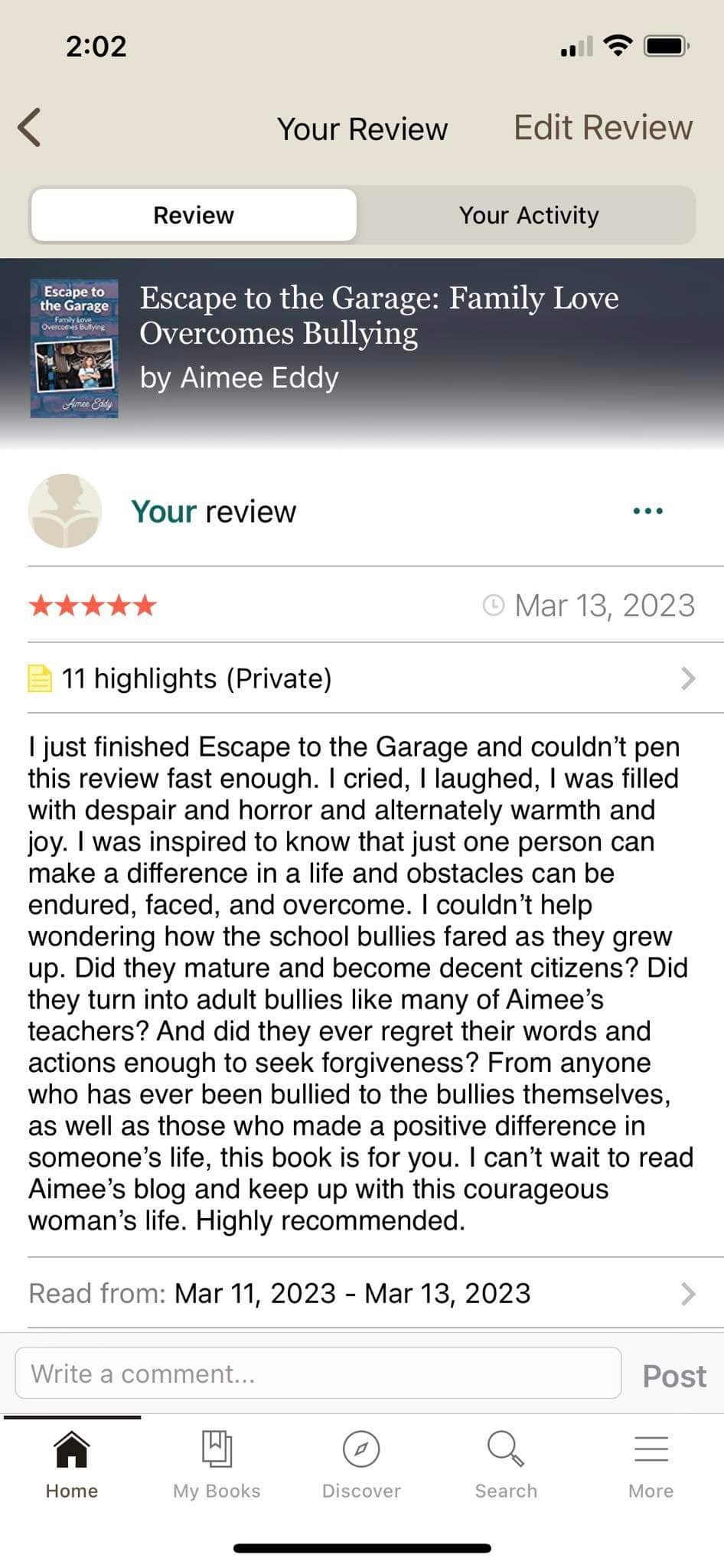
How can you help me with my book? The best gift you can give an author is to write a review. You don’t have to be good at writing to do a review. Just put down what you like about my book. You can go on Amazon or Goodreads and post a review. Reviews help sell a book. Good reviews tell readers “This is a book you want to buy.” If you have bought my book, please consider writing a review.
Last week I did a promotion on the Kindle version of my book. It was on sale for ninety-nine cents for a week. I sold eighteen books. I consider that a success. I got an excellent review from someone who bought a Kindle copy. I hope more will write some reviews.
Many are asking me if I am going to write another book. Right now, I have not started on any books. My friend Roberta is organizing some of my blog posts for a book. I have plans to write about the years after the garage and I am writing down memories on index cards. I have written an article about adding emotions to memoir which I hope to submit to Pennwriters’ newsletter. Otherwise, I have not done a lot of writing. I put a lot into Escape to the Garage: Family Love Overcomes Bullying and I just need time to sort out my emotions to write another book that deals with powerful and painful memories.
Speaking out against bullying and bringing awareness to the damages it causes help me stand proudly in the light of recovery.
Aimee Eddy’s memoir Kindle is just 99p/99c at the moment. The sale goes on until March 17. Get your Kindle book Now before it’s too late!!! You have two days left!!!!
“Honest, determined and deeply emotional, Author Aimee Eddy provides an in-depth look into her life growing up and being bullied. Her imagination sustains and ultimately fuels her courage to move forward. A powerful read.” -Amy Bovaird, Author, Seeking Solace: Finding Joy After Loss
“Aimee shows a strong viewpoint of her childhood through her own personal lens. Escape to the Garage is very personal, educational, heart wrenching, and emotional.” -Alexander J. Kovarovic Executive Director and Founder / One Life Project & Our Colors United
“Aimee Eddy gives a highly emotional, target’s eye account of the bullying she suffered as a child during school. This book is an emotional roller-coaster and one you won’t be able to put down!” -Cherie White, former target of bullying, anti-bullying advocate, blogger, and author of From Victim to Victor (A Survivor’s True Story of Her Experience with School Bullying)
Unable to do classwork in first grade, Aimee Eddy is called a retard by her teacher.
This label follows her throughout elementary school and forces her to endure daily bullying from classmates and teachers. Low self-esteem and hopelessness threaten to swallow her.
Despite the hardships at school, she finds love and acceptance in one place—the family garage. There, Aimee, her siblings, and cousins disappear into their imaginations as they build forts in the junkyard and roll down hills in inner tubes. The support she receives from her family at the garage gives her the courage to withstand the deep depression school produces.
Then tragedy strikes, and the family loses the garage. Without this place of refuge, how will she find the strength to stand up to bullies?





















 aimeeeddy.com