November is the month to be grateful for the things in our lives we have and for the family and friends God has blessed our lives with. In this month centuries ago Indians and pilgrims put aside their difference and sat down at a feast to give thanks. Many put on social media something they are thankful for each day of November. When struggling with mental illness, it’s hard to look past the dark hole to what they do have that is good in their lives.
A good way to combat the darkness is to start a gratitude journal. Take a notebook, a journal, or put papers together in a folder and on the front write “Gratitude Journal.” Each day write things you are thankful for. It doesn’t have to be anything big. It can be something simple like waking up in the morning. If you’re an artist draw something you are grateful for.
Let me give you an example from my life. Here are some things I am thankful for.
Date: November 25
I’m thankful to wake up next to my husband.
I’m thankful for Thanksgiving dinner at Cracker Barrel.
I’m thankful for phone calls to family.
I’m thankful for not having to cook.
I’m thankful for a relaxing day.
I’m thankful for Christmas movies.
I’m thankful for a ride in the country even though it was raining.
November 26
I’m thankful to have a home.
I’m thankful I woke up this morning.
I’m thankful for my husband being there when I had a meltdown and cried in his arms.
I’m thankful for my friends and family to turn to when I’m feeling discouraged.
I’m thankful for my dog who always knows when I need extra cuddles.
November 27
I’m thankful I made it to the bus stop without falling on the ice.
I’m thankful my manager was able to give me some hours to work next week.
I’m thankful for my customers who were nice today.
I’m thankful for a dinner out tonight.
I’m thankful I could help a friend with produce codes.
I’m thankful I could spend some time with my husband tonight before he went to bed.
Now you try it. Take out a piece of paper or a notebook. Grab a colorful pen or pencil and start writing. Look around you. What do you have in your life to be thankful for? Do you have a home? Do you have friends? Did you get up this morning? Did you watch a movie you really like? Did you call a friend or family member? Did you eat today? All of these are things to be grateful for. Even though they seem small and meaningless, they aren’t. They are wonderful parts to your life. For many just getting out of bed is a big accomplishment. So be grateful for that.
I know your mind and heart may be clouded, but while you sit at the bottom of the hole there are still good things all around you. It’s hard to see when your soul is being tormented, but positive things exist in your life. Now look around, find them, and write them down. Start your gratitude journal today.
It took me a while to find stuff to be thankful for, but now that I’m in recovery I have found many wonderful things in my life. I’m grateful to be in the light of recovery.
One of the most misunderstood illnesses is mental illness. It’s an illness you can’t see. Television comedies make fun of it, and the news programs point it out whenever mass killings take place. Years of stigma have accumulated when we discuss mental illness. It’s hard to see an illness of the mind as a serious illness, and it’s often associated with people who are dangerous or eccentric. Because of misunderstanding and stigma, many who struggle with mental illness go untreated because they fear they will be judged.
Years ago, when I came home to my ex-boyfriend and found he had packed my things “he couldn’t handle me anymore,” I put my hand through a window. He called his mom who then sat at my side, rubbing my back, and telling me if I had treated her son better, he wouldn’t have kicked me out. I was bleeding and crying uncontrollably, and yet he didn’t call my parents until I was taken to the hospital.
At the hospital the doctor asked if he needed to numb me while he stitched up my hand since I was a self-injurer. He assumed I liked pain. He had no idea what self-injury is. I didn’t injure because I liked pain. I injured because the pain on my body relieved the pain in my soul. It was am unhealthy coping technique and a cry for help.
When my parents finally came, I cried and pleaded, “Don’t put me in the looney bin. I’m not crazy.”
I was misinformed by stigma and television. Many refer to the mental health hospital as the looney bin when it is a hospital that treats people with serious mental health problems. No hospital is a fun place to go to, but they are necessary to treat illnesses. Without doctors, nurses, and in mental health hospitals psychiatrists, many patients would suffer and die without proper treatment. Patients in the mental health hospital are not crazy; they are sick. It took me some time to realize that the hospital was where I needed to go to start on the road to recovery.
I took several months off while working on my recovery. My mom helped me investigate places for counseling after the hospital. I had moved back home with my parents in another state. I was just on leave from work and still had health insurance. The common problem I faced was that many felt that I would never return to work, and I would not have health insurance that would cover the costs of my treatment. I finally had to use my sister’s address to join a therapy group paid through by the state. My sister lived in the state. Then my therapist filled out paperwork for me to go on social security disability. She insisted that a person with mental illness could not work. I told her I was going back to work, and I ripped up the paperwork.
After several months off I finally returned to work, but in a different department. It was leaked by another employee I was a self-injurer. I was put in the bakery department and the employees asked me if I were safe to use knives. Then each time I got a paper cut they asked me if I did it on purpose.
One day I made a mistake on a cake order. The manager gave me a long, angry lecture. I went in the back, squatted, and cried. I had a closed box cutter in my hand because I was using it before I got in trouble. I was taken by a manager to an office and was locked in there and forced to talk to a mental health crisis worker by phone. The managers assumed I had injured myself when I did not. When I took it to the union, we met with the store manager, and he said because I had mental illness managers could do what they wanted. They thought I was a danger to the employees and customers. The union did little to defend me and I was labeled dangerous.
What they did not know was most with mental illness are only dangerous to themselves. I never hurt anyone but myself. No matter how many times I tried to educate my bakery manager on self-injury, she refused to listen. Self-injurers hurt themselves in a private place like in their bedrooms or bathrooms. They hide their injuries because they fear what others would think or say. Self-injury is a very private thing. The only time an injurer would do it in public or tell someone is if he or she were desperately calling out for help.
My illness was misunderstood by my fellow employees, my manager, and the store manager. They judged me based on their own lack of knowledge and stigma. I was treated unfairly, and for reasons like this many struggle in silence. There are a lot of people struggling with mental illness who are afraid to ask for help because they fear they will be judged and misunderstood. They shouldn’t be afraid to ask for help, they shouldn’t fear being judged, but they do. Our society needs to be educated about mental illness and stigma needs to be dispelled. Look around you, how many of your friends, family, and co-workers are suffering alone because they fear how they will be treated?
It wasn’t until I started writing this blog that I learned of several people who had been struggling with mental illness alone. Some of their families won’t speak to them because they just can’t comprehend an illness of the mind. No one should be afraid to ask for help. Educating the public about mental illness begins with us, those who have fought the fight and those who are fighting it. We need to tell the world the truth and we need to educate people about this greatly misunderstood illness. It’s our job to fight stigma and pave the wave for those who need help but are afraid. We are humans with a serious illness that in most case can be treated. Many of us can live productive lives with proper treatment.
I educate people with this blog. If you have a story to tell and are comfortable at writing it, let me know and I will help tell your story though this blog. Because I write this blog, I am bringing understanding and fighting stigma one person at a time. Writing my story helps me stand proudly in the light of recovery.
I’m sick so here is a older post. Hopefully I will be well by next week to write a new post.
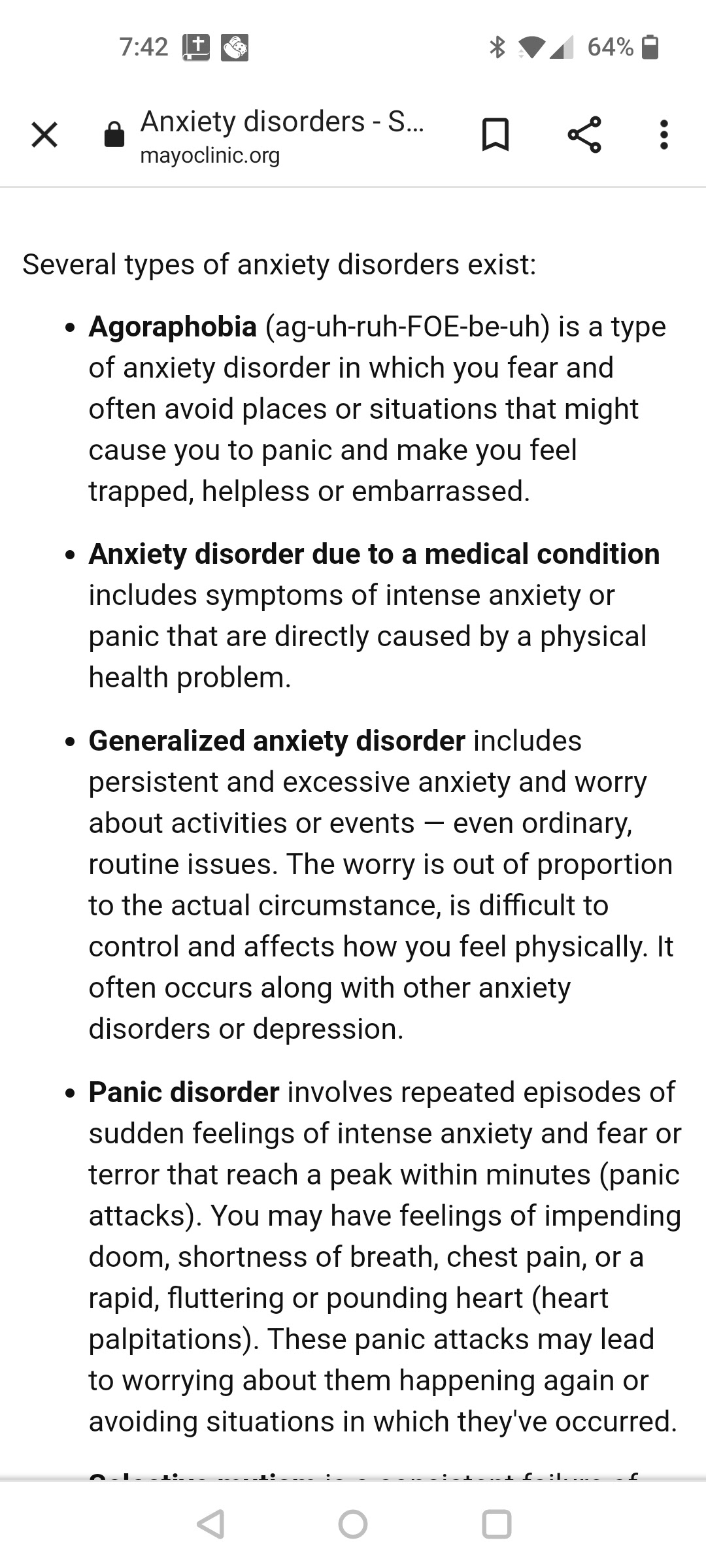
Anxiety comes in different forms for people. Some can’t breathe; some feel like they are having a heart attack. Some have tightening of muscles, some become dizzy, and some get cold or sweaty hands and/or feet.
For me, it comes like a rare flu I can’t get rid of. I become nauseated, I dry heave and sometimes I’m over the toilet.
I first experienced this anxiety attack in college while I was being abused by a friend. I woke up each morning feeling sick, I could hardly keep food down and during the day I would dry heave. Sometimes I’d dry heave until I got sick. I’d be fine one minute and sick the next. A doctor gave me anti-nausea medication and it did little to ease my stomach.
When the abuse ended, the anxiety attacks went away for several years. They came back suddenly, without warning. My life was going well. I had married a wonderful man, I worked at a good job, and I had been in recovery from my mental illness for several years.
I had a doctor run several tests to rule out health problems. I couldn’t believe I was having anxiety attacks at such a good time in my life. The doctor found that I was healthy, and he put me on xanax. The nausea went away as long as I remember to take my medication.
In therapy I was able to point out different things in my life that caused stress: things like worrying about finances, work, taking care of my home and health problems. My therapist and I started working on ways to take control of my worries and to relax. My husband’s Uncle Richard Gross, a clinical psychologist, gave me a relaxation tape which helped calm my nerves.
My psychiatrist told me many people with depression have anxiety. He said the illnesses are different and they were not the result of having one or the other. It’s just one of those things that seem to go together.
With the help of medication, relaxation techniques, and therapy, I keep my anxiety attacks under control. There are times they get the best of me, but I know I can stand up to them. I have a wonderful husband who reminds me when I’m worrying too much. It helps to have a friend or family member to share my problems with. Having someone to remind me to relax or to help me calm down is important.
With relaxation techniques, my support team and medication I stand in the light of recovery facing my anxiety with strength.
Last week I was on vacation and my husband got a bad cold. For a change I have stayed healthy knock on wood. So instead of my husband taking care of me I took and still am taking care of him. It’s a nice change for me to get to give back to him by being the caregiver.
Since I’ve been busy taking care of him I didn’t write a post this week. I will write a post for next week. Until then remember to keep fighting to reach the light.
In elementary and high school, I disappeared into my imagination to escape the bullying I faced. It was so much easier than dealing with the real world. In my teenage years, I began to write down my daydreams and I put them in folders. I would put the title of the stories on the front of the folders. I would sit for hours writing and escaping into a world I could control. When a teacher told me I was talented, I began to enter contests and submit to magazines. It was also when I started to dream of having my own book published.
In seventh grade I wrote stories for the school magazine and by ninth grade I had my first story published in Creative Words magazine a magazine that published stories written by kids of all ages. I had several short stories, news articles, and essays published since then. I even had my own column in a local newspaper.
In 2019 Alexander Kovarovic asked if he could put two of my essays in his book Change Your Life. He told me it would be an advice book for teens. I was excited and honored. I had already been writing blog posts for his nonprofit organization and he loved my work. It wasn’t my own book, but it was a steppingstone. It’s a publishing credit that will look good when I’m ready to send my own manuscript out to publishers.
In 2019 the book came out with my essays in it, one on bullying and the other on depression. Alexander sold me copies of the book at a lower price. I in turn sold the book to friends and family. I signed the books and indicated the pages my essays were on. I felt like an official author signing books and selling them. The money I made from the sales helped pay for a partial scholarship to Saint Davids Christian Writers Conference.
I also had a chance to do a book signing at a craft fair in my hometown, but unfortunately it wasn’t advertised well and not too many people showed up. I sold one book. It was disappointing. I had bought several copies of the book that for a few years sat in my office slash storage room gathering dust. Until recently.
My friend and fellow author Amy Bovaird told me she was setting up a book signing and invited me to join her and two other authors. She said I could sell and sign the book I’m published in, Change Your Life. It’s good practice for when my own book comes out. I must do my own advertising for this book signing. I have sent out numerous invitations online and have told several people about the book signing. Several said they will try to come.
So here is my invitation to all of you who live in the Erie area. Please come help me take another step in my writing career. The book signing is November 10, 2p.m. to 5 p.m. at The Crick, 236 West Main Street, Girard PA. It’s a Christmas theme so I will also be selling some of my woodburned Christmas ornaments. Come see me and three other authors.
My memoir is with a second editor who is doing an in depth edit. She is pointing out details I didn’t think about. It’s taking some time. She does the edits and sends me the chapters with suggestions and her corrections. I make some corrections and send it back to her. Then she makes the actual edits in the manuscript. I’m glad she’s picking out these details. I want my manuscript to be the best it can be.
In time I will be selling and signing my own book. For now, I am learning the process of selling and marketing by participating in book signings like I will be doing on November 10.
When I was a kid, I wrote to escape the pain in me and the bullying I faced. Now I write about my own experiences to educate and help others. I advocate against bullying and I advocate for those with mental illness through my writing. I think God gave me the talent to write to help others. My essays in Alexander’s book were written based on my own experiences. You must buy the book to find out how valuable they are to all who face depression and bullying.
I fought many battles and have struggled through some very hard times to reach out to the world and touch them with my writing, and this helps me shine within the light of recovery.
We all experience life with different perceptions. We go through life’s struggles and each person’s journey is different. What may seem like a minor bad point in a person’s life may seem like a major one in another person’s life. Someone may feel sad about a situation, while another person may feel happy. No person on earth experiences life the same or feels the same emotions as another. Everyone’s feelings are valid even if we don’t feel the same or understand them.
Feelings are a tricky thing especially when it comes to mental illness. It is so hard to understand why a person with a good life could fall deep into sadness. It’s even more difficult to understand how a person could feel so hopeless and depressed that he or she would want to commit suicide.
A friend’s aunt came in my line at work. I told her that her nephew was really struggling with depression.
She looked at me and said, “What does he have to be depressed about?”
I was taken back by her response. It was like she couldn’t understand her nephew’s feelings of sadness. This happens a lot to people with mental illness. Many don’t understand those struggling and they shrug them off like their feelings are not important, when they are very important.
After my mastectomy I struggled with grief for the loss of my breasts. Many of my friends told me that I didn’t need them anyway and I should be happy they were gone. Some said they were envious of me and would love to get rid of theirs. I felt like they didn’t validate my feelings of grief and depression. This made me feel even worse. It’s like my loss was a joke to them, and it wasn’t. I lost a part of my body, a part that made me a woman, and yes at times I wished I didn’t have them, but when it came to having them removed, it was like a piece of me was stolen from me. The hardest battle for me with breast cancer was dealing with my loss, and having friends who didn’t take my grief seriously made me feel even worse.
This has happened with my mental illness too. I had lived two years in recovery from mental illness. I had friends, I was living in an apartment with a friend, and I had a boyfriend. Then suddenly I fell down that hole of depression. I felt hopeless, depressed, useless, and worthless. Some people didn’t take my feelings seriously. It didn’t make sense to them that I would feel those emotions when it seemed like I had a good life. To them I had no reason to feel bad. This made me feel even more alone. The more my feelings were not taken seriously, the worse my depression got.
Years after I recovered from mental illness, I went to a friend’s house for a dinner. There was a group of us. They talked about a girl we all knew. The girl got upset and locked herself in the bathroom during a party. The girl told them her life was hopeless and she felt like she had nothing to live for. The group of girls who told me about it said that she was doing it for attention. They didn’t take her feelings seriously. They thought she was a joke when she was crying for help. To the girl her feelings were real and very overpowering. By locking herself in the bathroom and telling the group her feelings she was begging for help, and they didn’t listen. By not validating her feelings and noticing her call for help they made her feel more depressed, and she injured herself.
When I was in school there was a girl who kept talking about taking her life. I knew nothing about mental illness or that I was suffering with it. I thought she was telling us that for attention. She told me she was sad, and I thought she was a spoiled child craving attention. The teachers at my school never took her cries for help and feelings seriously either. She never got the help she needed because no one would listen to her or validate her feelings. I found out many years later she struggled with mental illness and was never able to get the proper help she needed. She has been living in an inner hell since she was a kid and it led to a very rough life.
Everyone’s feelings are real and valid even if we don’t understand them or find a good reason for them. With mental illness the darkness, the feeling of hopelessness, the worthlessness, and inner anguish is very real. Not recognizing the person’s feelings and letting him or her know you acknowledge how they feel can be detrimental. It can lead a person deeper into his or her mental illness and can lead to suicide attempts or suicide.
When a person turns to you and tells you he or she is feeling depressed, that person is confiding in you and asking for help. Say you’re there for him or her, suggest he or she gets help, and listen to him or her. Don’t brush the person off or ask them, “What do you have to be depressed about?” Never assume the person is just trying to get attention. Don’t turn that person in to a joke you can talk about with your friends. Those feelings the person has been struggling with are very real, and if he or she is telling you about them then it is to ask you for help. Don’t ignore him or her. Validate his or her feelings.
Many years ago, when I confided in my mom my feelings, she went out of her way to get me help. Because people who care about me, friends, and family, validated my feelings, I got help and I dance in the light of recovery.
I had the chance to interview someone I knew since my school years. Since I was held back in first grade, she was in the class ahead of me, but we are the same age. I lived next door to her older sister and nieces and nephews as a kid. She was a late in life child. I knew she struggled with something in school but didn’t know what until I was an adult and learned about mental illness. She has had a rough life and I believe her story needs to be told. This special woman is Mary Swabik and she is a friend whom I admit I misunderstood as a teen. I am so glad we reconnected.
Here is my interview with Mary.
What type of mental illness do you have?
MDD (Major Depression Disorder), anxiety, and PTSD (Post Traumatic Disorder)
What are some of your symptoms?
I have panic attacks and things that trigger them. I am never happy, I have to force myself out of bed and to do daily activities.
What has caused your PTSD?
I faced abuse starting at age ten when I was raped by my uncle and cousin. I was physically and verbally abused by my mom. She would tell me that I would never amount to nothing, she said I couldn’t talk right, and that I would end up in an institution.
In a special school I attended, I was locked in the cooler for not eating my lunch. I was also in several abusive relationships.
How has your family reacted to your illness?
They have not been in my life for twenty years. I only have contact with my oldest daughter.
Do you have positive relationships in your life?
Most of my friends are older and we go to church together. I have several mother figures in my life.
Has your illness led to bad relationships?
I had gotten into abusive relationships with ex-husbands and female friends.
What has helped you cope with your mental illness?
Talk therapy and God. I have been in and out of mental hospitals since I was nineteen, and I have been in a state hospital for eighteen months.
Do you have any coping techniques?
Breathing into a bag, praying, and talking it out.
What advice would you give to others struggling with mental illness?
Take your medication, find a good counselor, and have a support team. Mental illness is not your fault. It is an illness.
What advice would you give to other women being abused?
Get out of the relationship and it’s not your fault. Most importantly get help. If it’s physical call the police and press charges. Don’t ever drop the charges. Stay away from the abuser no matter what he promises.
What steps are you taking to reach recovery?
I take one day at a time. I pray and I have people pray for me.
Mary has lived a rough life and deserves our support. She has many struggles in her life and could use your prayers. She grew up in Ripley, New York and now lives in Florida. She has a kind soul and has a strong faith that helps her through the many heartaches she has faced. She is a survivor in many ways and will someday be standing in the light of recovery with God carrying her.
God gives authors the talent to write, but to hone and improve your writing you must be willing to learn. Writers learn new techniques from books, writing groups, conferences, and workshops. No matter where you are in your writing career, there is always something to learn. No author sits down and writes a publishable book without ever studying the craft of writing.
I have been going to writing conferences since high school. My first writing conference was a summer enrichment writing program an English teacher who helped me with my writing selected me for. The program was for students who were talented. The program took place at Chautauqua High School which was about a half hour from our home. A bus took us there each day for a month during the summer. For an hour we learned about different techniques of writing; then for another hour we went over to the Chautauqua Institute. Our instructor would give us a writing assignment and we would find a place at the institute to write and something to write about. The institute is a wonderful place with lots of history: it’s a center of many arts, it has old fashioned summer homes, gardens, and special places like the Hall of Philosophy. I learned and I was inspired.
Then the English teacher gave me a brochure for another writing conference at a college during the following summer. My parents scrounged up the money for me to go and then they drove me there, many miles away. I spent a week going to different workshops on different aspects of writing and different genres of writing. I was rejected at my own school, but I was accepted among my fellow writers. I made friends who had the same passion I did, I learned, and I was inspired.
My senior year of school I collected donations from local businesses in my hometown and flew to Washington, DC for a journalism conference. I was given the chance to interview a senator of New York State. Each time I returned from the conferences my writing improved and my knowledge grew. My English teacher noticed a difference in my personality. She said I was happier, and she was right. The conferences were the one place I fit in and I got to study what was my passion.
The conferences continued as an adult when I joined Pennwriters. I started going to their annual writing conference. The conference was from Friday to Saturday at a hotel out of town. I loved going and learning. I also started going to Saint Davids Christian Writers Conference which was held at a college. Through the conferences I made more friends and continued to learn.
When I got married and moved out of my parents’ home, I began going to Saint Davids whenever I could get a scholarship and I could no longer afford to go to the Pennwriters annual conference. Luckily Pennwriters started putting on one-day conferences in my hometown. It was and is perfect for me. It’s affordable, there’s a variety of workshops to choose from, and lots of fellow writers to talk to, some I know and ones I meet for the first time.
This Saturday was Pennwriters Road trip 9, their one-day conference. For each hour there were three workshops to choose from like editing basics, finding your character’s emotional wound and character arc, and hitting your story beats. The workshops started at nine a.m. and went to four thirty p.m. with a half hour for lunch. I’m a member of Pennwriters and I attend their meetings, so I reconnected with friends and I made new friends.
In the workshops I learned about editing, formatting a manuscript, making a set time for writing, using your senses in your writing, how to look out for scammers in the writing field, and much more. Workshops were taught by authors who are published and used the techniques they teach or have important information to share. There was so much to take in that my head was whirling, but yet I was inspired.
Not all techniques that are taught work for every writer. What we do is take a little bit we learn from different workshops and find ways that work for us. Many authors suggest you sit at a desk in a quiet room where you can’t be disturbed and write. Others listen to soft music when they write. I sit on my couch with a lap desk and the television on. Once I get to writing the TV just becomes a hum in the background. I write at night when my husband is in bed and it’s just me and my dog. I took a little bit of advice from other authors and found something that works for me: my alone time is when my husband is in bed and my music is the hum of the television.
I love going to workshops not only to hone my writing, but to be inspired, and to talk and network with other writers. Many of my good friends are fellow authors who helped me grow as a writer and as a person. My friend Amy mentors me in memoir writing, my friend Catherine has taught me a lot about writing and helped me with editing stories for magazines, contests, and my memoir. My friend Roberta edits these blog posts, and my friend Kathy has edited my synopsis and memoir. My friend Todd is always encouraging me and giving me good advice. All these authors have helped me grow and there are many more who have helped and taught me a lot.
Writing is my passion, my talent given to me by God, and my therapy. It helps me with my mental illness, and it gives me a chance to help others. I always tell people if you want to get to know me, read my writing because I put all of me in the words I put on paper. I spill out my heart and soul with a strike of keys on a keyboard.
What’s your passion and how do you hone it? Does your craft or creativity help you with mental illness? Can you use it to help others? Pick something that you love to do and something that helps you deal with your struggles and find ways to hone it. Learn about it and meet others who have the same passion. This will help you make friends, express yourself, and help others. It will also be therapeutic to you.
Writing is my passion. Nothing will ever stand in my way of learning and making my writing better. Because I write I stand in the light of recovery with stories filling my mind.
I remember when you were so sick that you felt life was hopeless. You thought there was no end to the sadness, the inner anguish, the crying spells, the sleepless nights, and the overpowering emotions. You thought the only way to stop it was to take your life. You planned it and you tried but never succeeded. You thought your family and friends would be better without you, but you were wrong.
I want to thank you for never taking your own life and for your failed plans. If you would have committed suicide, you would have missed out on watching your nieces and nephews grow up. Taking them to do fun things, spoiling them, and sharing memories with them. They would have never gotten to know their favorite aunt if you were gone. They would have only heard stories about you. By living you have instead given them love, courage, and many wonderful memories. Since you lived you have been blessed with two great nieces and a great nephew. On Friday you watched your oldest niece get married. It was a wonderful wedding. Your nieces and nephews have been one of the greatest blessings in your life.
Remember when you wrote out what you wanted to go on your grave, “A lonely soul who couldn’t go on.” Good thing you never had to use it. If you had died, you would have never met the love of your life. On the first date he drew you in with a promise to treat you like a woman, to protect you, and to never hurt you. He swept you away. You couldn’t stop seeing him. He even rode his bike thirty miles to see you. Within just six months of dating, he proposed, and you knew your souls would be one forever.
What a beautiful wedding it was! You could have missed the best day of your life. The day you said “I do” to the most wonderful man you ever met. The day you pledged your heart and soul to him forever with tears in your eyes. Now you have spent fourteen years of marriage creating memories, sharing your love, standing side by side in ups and downs, and falling more in love each day. You can see the love in his eyes, in the things he does, and how he takes care of you. Wouldn’t it have been so sad if you would have missed that?
Remember when you took a bunch of pills and somehow drove to college in a snowstorm and back without remembering how. God took the wheel for a reason. He drove you to class and back because he had plans for you. Because God kept you alive, you have fought hard and reached recovery. In this blog you write about what you learned in therapy and your journey to recovery. Many have told you how much your posts have helped them. You would have never been able to do that if you took your life. You have written a memoir that will help many when it’s published. Because you are alive, you will soon see your first book published.
You touch many lives as a cashier. Customers stand in long lines to see you and pray for you as you face health problems and rise above them. Many call you an inspiration because no matter how far down you fall, you always pull yourself up. You have many friends who you’ve touched in many ways. Friends who you call sis, ones who turn to you in a time of need, friends who support you, friends who stand at your side no matter what, and friends who have helped you grow as a writer. What if you missed out on all this? How sad would that have been?
One time you thought none of this was possible. You thought you would be stuck in your internal hell forever. Look how wrong you were. Your life turned out wonderful because you didn’t succeed at suicide. How could you have ever wanted to miss out on such a wonderful life? You thought you would never feel happiness again and now you are very happy. Yes, you still have bad days, but you have coping techniques and a special support system to get you through. You have struggled with many health problems, but you have a wonderful husband who helped you through them. Your life isn’t perfect, but it is wonderful.
Thank you, Aimee, for being alive and for pushing forward. You’ve had many challenges and rough times, but you have risen above them. If you were gone you would have never gotten a chance to rise above so much and to write about it. If you took your life, you would have never experienced true love, joy, and love of friends and family.
Your life is beautiful. Thank you for living it. Thank you, God, for not letting Sick Aimee succeed at suicide. Suicide was never the right answer. I forgive you for being misguided and rejoice in the life you have lived because you never took your life. You stand in the light of recovery a strong, vibrant, and inspirational woman because you chose life.
When a woman goes through breast cancer, she is often put on hormone therapy for different reasons: to reduce the chance of the cancer returning, to reduce the size of the cancer, or to control breast cancer that has returned. This therapy is given by a pill that the woman must take for five or more years. A major side effect of this type of pill is the weakening of bones and osteoporosis. While on the pill, women are told to take calcium and vitamin D to help prevent osteoporosis, but sometimes that is not enough to stop it. The inevitable happens.
Because I am on the hormone therapy for having breast cancer, I get bone destiny scans every two years. I recently had a scan towards the beginning of this month. Wednesday I went for my six-month checkup at the cancer center. The physician’s assistant came into the exam room and asked if I had seen the results of my bone scan on the mychart app. I never read those because I don’t understand them. I prefer the doctor explain the results of my tests. So, I hadn’t read it.
She looked at me with sympathetic eyes. “I’m sorry to tell you, you have osteoporosis.”
I felt like I was kicked in the stomach. I couldn’t think and tears welled up in my eyes. I fought to control them. I told her I had back surgery in October for a broken bone and asked her if it could be related to the osteoporosis. She told me that it was what caused it, because the bone weakness is worse in my back especially in the lumbar.
I was in shock. I couldn’t process my new diagnosis. I’m only forty-seven years old and I have osteoporosis. This had to be a nightmare. I thought it was a nightmare when they told me I had cancer and it wasn’t. This too was real. The assistant went on to tell me of three options to treat my condition. My husband asked her which one she would suggest. She suggested an infusion I would get every six months. The infusion would take thirty minutes and it would also protect me from bone cancer. We agreed to that.
It wasn’t until I got home it started to sink in and questions began to surface. For almost a year now I figured I had broken the bone in my back and had surgery because I have scoliosis. Now I find out it is because the bones in my back are weak. When I first felt the horrible pain in my back before my surgery, I was doing my job, reaching to clean the belt and lifting heavy items. Does this mean doing my job is dangerous to me? Could I break another bone in my back doing my job? Would I have osteoporosis for the rest of my life? How long will I have to have infusions for? Are there restrictions for work?
After the questions, I started going through the what ifs. What if I’m walking to work and I fall beside the road, break a leg, and no one stops to help me? What if I’m walking downstairs in the morning and I fall down the stairs, breaking several bones, and am unable to reach my phone to call for help? What if at work I lift a twenty-four pack of pop and I break another bone in my back? What if a customer bumps into me, I fall, and break my hip? The what ifs started small and kept growing bigger and bigger. I began to imagine myself in those situations.
This new condition became a life altering tragedy. I’m a very emotional person. I feel emotions strongly and sometimes they lead me back to that hole of depression. Part of my mental illness is feeling things more intensely than others. Finding out I had yet another health problem brought a flood of emotions. I was sad, angry, scared, and frustrated. Once we left the cancer center, all I could do was cry. For several days I went in and out of crying spells.
Cancer stole my breasts from me, because of it I had a hysterectomy, and now I have osteoporosis. This is just not fair. How could I get osteoporosis at the age of forty-seven from a medication I take? Why me? How could I have another health problem? Damn breast cancer has taken so much from me and it doesn’t stop. It keeps kicking me and pushing me down. I’ve been cancer free for three years and now this. I feel like a porcelain doll that could easy break if not taken care of properly.
I asked my friend Kelly if I was magnifying my diagnosis. She told me she felt I was and that many women live full lives with osteoporosis. My friend Cheryl said she knows how emotional I get about things and how I magnify things.
When I think about it both friends are right. I have taken this diagnosis like it’s a life ending condition, but it’s not. With treatment, exercise, and calcium and vitamin D supplements, I can live a full life. I may have to do light duty at work, which is express registers, but I like those registers. No heavy lifting. If I take care of myself, I may never break a bone again. I’m only on the hormone therapy for two more years. I can kick myself through this disease and not let it defeat me.
Breast cancer is an awful disease. The medications for it can takes their toll on our bodies. It also takes a toll on us mentally. It’s easy to feel hopeless and get sad. If you already have mental illness, it can push you backwards into the dark hole of depression. This illness is like a kick in the gut. It keeps kicking you until you’re on your knees, but you can kick yourself back up to your feet. Don’t give up. Fight breast cancer and fight mental illness.
I must get an exam and blood work before I start getting infusions, but I’m no longer going to let this new health problem drag me down. I’m standing in the light kicking at whatever tries to pull me down.