Friends come and go in our lives. Each friend makes a different impact on your life and heart. Even bad friendships teach you lessons. Some friends are only meant to come in your life for a short time, and some span over many years. Those that last for many years are very special and only get stronger through the years. Barb was one of those special friends that lasted for many years.
I met Barb almost twenty-nine years ago as a regular customer of mine at the grocery store where I work . She had some problems walking and talking, but it didn’t stop her from coming in the store regularly to shop and visit me. First, she came to me when I was a bagger. I packed her groceries and chatted with her. Then when I became a cashier, she started coming to my line even if she had to wait a while. Our store had a play area for parents to leave their children while they shopped.
Barb would smile at me. “I think I would love to work with the kids. Do you think they will hire me?”
I sent her groceries down the belt. “I’m sure they would. Stop at the service desk and get an application.”
“I will and I’ll put you down as a reference,” she said.
I don’t think she ever filled out an application, because each time she came in, she talked about working at the area where the kids played. I kept encouraging her to apply.
Then I had to take some time off for sick leave after my relationship with my abusive ex landed me in the mental health hospital. When I returned to work, I was moved to the bakery. Barb found me in the bakery and would stop by to say hi and chat with me while I worked. Even though she had some problems walking, it didn’t stop her from walking around our big store. She didn’t let anything stand in her way.
Then I met my friend Kelly at Saint Davids Christian Writers Conference and learned she lived in the same city where I worked. Kelly invited me to attend her Bible study group held at her church. I agreed and showed up.
Barb came strolling in late and pointed at me. “Hey, I know you.”
It wasn’t until that Bible study group that I learned Barb’s name and we started a friendship. After that Barb invited me to her home for picnics, parties, and to visit. I learned that Barb loved to host parties. The more I got to know her, the closer we became. Barb reminded me of myself in many ways. She was determined and she wouldn’t let anything stand in her way. Just like I wouldn’t let bullying and mental illness to stand in my way.
When I met my husband, I introduced her to him and he started calling her, “Barbra Streisand,” and it put a big smile on her lips. In time her walking and talking became harder for Barb. She was diagnosed with cerebral palsy. I encouraged her to use a motorized cart to shop at the store.
“As long as I have a cart to lean on, I can walk on my own,” she told me.
She wasn’t about to let the disease win. She pushed forward and when I asked her if she needed help to her car, he told me she wasn’t an elderly person, she could do it. The longer I knew her, the worse it became for her to walk and talk. I had to learn to interpret some of what she said, and even though she moved slower, she still walked around the store. She was too determined and stubborn to give in.
She lived in a home that had many stairs to get to the first floor. At first, she did them well while holding on to the rail, but then she became slower and eventually had to slide down each step, but like the grocery store, she wasn’t going to let the stairs defeat her. Barb was inspiring.
When she started using a walker and eventually a wheelchair, I knew the cerebral palsy was becoming worse, but even though she needed help, she wasn’t a quitter. At home she used railings that were installed to help her walk around. She struggled but pushed on. Her speech became even worse and understanding what she was saying became even harder, but it didn’t stop her from trying to get her words out. I could hear the frustration in her voice as she tried to talk to me. It finally came to the point Barb could no longer visit me at work. I tried to call her and check on her, but felt bad when I couldn’t understand what she was saying to me.
Eventually her daughter had to move her to assisted living. I planned to visit her during my vacation the week after Father’s Day, but I got sick and then my husband got sick. Before I knew it, her daughter posted on Facebook she was in respiratory distress and she wasn’t sure if Barb would make it through the night, but Barb wasn’t willing to give up without a fight. Barb was transferred to her home and her daughter stayed at her side while hospice took care of her. I planned to go see her Friday after work to say my goodbyes, but I ended up taking my husband to the emergency room. Barb passed away after midnight on Saturday morning.
Barb fought all the way to the end. She never allowed anything to stand in her way; she pushed through her decline due to her disease with strength, determination, and stubbornness. She had a beautiful smile that lit up the room and loved to give from the heart. I don’t believe cerebral palsy won. She may have passed away, but she gained her angel wings and a new body. She has left an everlasting impact on my life and the memory of her will remind me how important it is to never let anything hold you down.
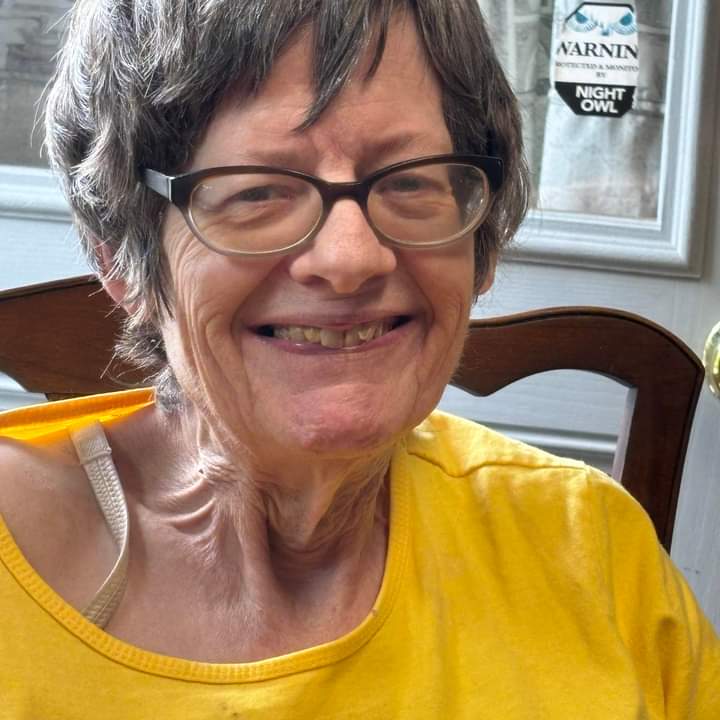
Barb has made my life brighter and inspired me to be stronger. Barb has entered the light of heaven and I will allow her memory to inspire me to never let anything to keep me from the light of my recovery from mental illness.
 aimeeeddy.com