LET’S TALK ABOUT MENTAL ILLNESS

We talk openly about cancer, diabetes, heart disease, eye diseases, and many others. We never judge people with physical illnesses. We know people have no control over these sicknesses, but it’s different with mental illness. Mental illness is not talked about as openly as physical illnesses. Many times when it’s discussed, it is met with judgment and stigma. Because of this many people do not understand mental illness and those who have it hide it fearing they will be judged.

When you have diabetes, you take medicine to maintain it, you change your diet, and each day you take care of yourself to keep this illness under control. Mental illness is not much different. With mental illness you take medicine to control the symptoms, you go to therapy to learn how to manage your illness, and you take care of yourself with coping techniques to keep your illness under control. Like diabetes you have a plan of action and care. Mental illness is like any other illness, yet the sickness is treated differently.

When I was a child and teen, mental illness wasn’t talked about. I didn’t know what it was or that I had it. I just knew something was wrong with me. I didn’t find out about mental illness until I found a pamphlet about depression at college. Even when I learned more about mental illness, I was afraid to tell people that I struggled with it. I’ve heard people talk about people with mental illness as being crazy, and I’ve seen TV shows that made fun of the illness. I didn’t want to be judged, so I put on a smile when I was out in public and fell apart when I was at home.

As an adult, I was hospitalized for my illness. After I was released, I returned to work only to be met by stigma and judgment. A co-worker asked me if I was in the looney bin. When I returned to my job, I worked in the bakery department. Every time I got a simple cut, they asked me if I did it myself. When I got upset at work, I had a box cutter in my hand, and the bakery manager assumed I hurt myself with it. I was forced to sit in an office to talk to crisis, a program that helps people who are really struggling, when I didn’t need to. Later the store manager said that managers could treat me as they needed to because I was a danger to employees and customers. If I’d had problems with any other illness, I would not have endured such judgment.

We judge mental illness because it’s a sickness of the mind. It’s hard to understand when the mind doesn’t function properly, but if we talk about mental illness more frequently and openly, then we can break the stigma. To talk about this sickness, we must also educate society. That’s why I write this blog post and work for One Life Project. I want people to see that mental illness is like any other illness, and we should put an end to the stigma.

If you struggle with mental illness, talk about it with your friends, family, and co-workers. Give them information about your illness or invite them to a therapy session. When I was dating my husband, he went to therapy with me to learn about my illness and how to help me. Let’s push schools and workplaces to talk frequently about mental illness. We need to stop judging mental illness and see it as equal to physical illness.

Many people are struggling in silence with mental illness because they are afraid if they tell someone, they will be judged. If we talk about mental illness without stigma, then more strugglers will ask for the help they need, and we can save many lives. I urge you to stop judging and start speaking out about mental illness.

I work hard to fight the stigma that surrounds mental illness so that some day we can talk about it as openly as we do any other illness. I now openly talk with others about my sickness, and this helps shine a light on my path of recovery.


SUICIDE AND SELF-INJURY

Many people don’t understand self-injury or even know anything about it. Many who hurt themselves do so in private and then they hide their injuries from others. It’s hard to understand why people would harm themselves on purpose. It is a misunderstood coping technique. Many people mistake self-injury for a suicide attempt, but it is not. However, suicide is still a risk factor.

Even though those who harm themselves do not injure to take their lives, that doesn’t mean they are not at risk. People who injure are sick and in pain. They have a mental illness, and with mental illness comes the risk of suicide. It’s important to take self-injury seriously. Don’t think it’s a way to get attention, don’t ignore the person, and make a joke about it. Look at it as if the person is suffering and needs help.

When I was self-injuring, I didn’t hurt myself to take my life. The physical pain released my inner pain. I felt so many overwhelming emotions that tore me apart inside. I was in agony. The only thing that eased that pain was hurting myself. Even though hurting myself wasn’t an attempt at suicide, I was suicidal. I suffered with depression, borderline personality disorder, and anxiety. My thoughts raced, I felt hopeless, I thought I was worthless, and I thought I was hurting my family by living.

When I was in college, I wrote a suicide note and planned my death. I thought of ways to take my life. One time I took a bottle of pills and got sick. I lived with my grandparents while I was in college, and my grandma thought I had the flu. I wanted to die because I was very sick. My mind was plagued with an awful illness that distorted my thinking.

No one injures themselves just for attention or for fun. They harm themselves because they have an illness that causes them a lot of emotional pain and suffering. It’s not a game or a joke. Every person who hurts themselves on purpose is suffering from some type of sickness and needs help. If they are hurting themselves, they are also at risk of being or becoming suicidal. So don’t walk away or laugh at them. Take it seriously.

The person might not be thinking about suicide when they are injuring. Self-harming releases endorphins that make the person feel better. The person could just be coping with his or her pain, but he or she is also struggling with a mental illness and can become suicidal at some point. By not ignoring self-injury you maybe saving a person from committing suicide in the future.

If a person shows you his or her injuries or you happen to see them, ask him or her if they would like to talk about it. Be willing to listen without judging. Encourage the person to get help. Tell someone who can help him or her. Don’t minimize the person’s feelings or pain. Look for the phone number for crisis or a helpline.

It took a while before I admitted to my mom I was self-injuring and that I was sick. When I told her, she went to great lengths to get me help. Because of my mom’s determination to get me help, I have not hurt myself in twenty-three years and I am alive. I stand in the light of recovery because I got help.

SELF-INJURY AND STIGMA

Due to the news, TV shows, and society’s misinformed ideas, there is a lot of stigma surrounding mental illness. Because of this, many who are struggling do so in silence, fearing what others would think of them. The sad part is many never get the help they need and end up using unhealthy coping techniques like drugs, alcohol, and self-injury. The problem is that stigma follows the unhealthy coping techniques too.

Self-injury is plagued with stigma and myths. People do not understand what it is, and they make untrue assumptions about it. Those assumptions leave the one self-harming feeling scared and alone.

Below are some myths that lead to the stigma surrounding self-injury.

  • It’s done for attention. Many think people hurt themselves just so others will feel sorry for them and give them the attention they desire. This is completely untrue. Self-injury is an unhealthy coping technique, a sign someone is struggling, and a silent call for help. It is often hidden so as not to bring attention to oneself.
  • It’s a suicide attempt. Self-injurers are not hurting themselves as a means to take their lives. It’s not a failed attempt at suicide. They are doing it to control powerful emotions, to feel something, or to punish themselves.
  • It’s done to hurt others. The only person the self-harmer wants to hurt is himself or herself. They have no intention to hurt anyone else. They usually hide their injuries under long sleeves or do it on parts of their bodies where no one can see it. If he or she shows his or her injuries, the person is telling you he or she is really struggling and needs help.
  • The injurer likes pain. Just because the person harms him or herself does not mean he or she likes pain. Many do not like pain at all, but they don’t know any other way to deal with their illness. The injury is a temporary relief and often the harmer feels guilty, ashamed, and sad afterwards. If a self-harmer gets an unintentional injury and needs stitches, he or she still needs to be numb. They don’t willingly want that kind of pain.
  • It’s caused by past abuse. It’s not done because a person was abused in the past. People who have never been abused self-injure. Anyone with a mental illness may turn to self-harm as an unhealthy coping technique or as a cry for help.
  • The self-injurer is crazy. People who harm themselves are not crazy. People with mental illness are often referred to as crazy when they are not. The dictionary defines crazy as mentally deranged, especially as manifested in a wild, aggressive way. People who injure and have a mental illness do not fit this description. They are struggling with an illness like any other illness, except it’s of the mind. They are in no way deranged.
  • Ignore self-injurers and they will stop. They may stop eventually with the right help, but you should never ignore them. The self-harmer is crying out for help and is silently struggling with something awful. Acknowledge that the person is struggling and help him or her find someone that can help the person. By ignoring them, you are telling them you don’t care, and this leads to more isolation and pain. Be supportive.

The best thing you can do for a friend or family member who is struggling with mental illness and self-harming is to educate yourself, be supportive, encourage him or her to find help, and be willing to help them get help. Don’t believe stigma or myths. Look for the truth. Knowing the facts can save a person from struggling alone.

The more we know about self-harming and the more strugglers tell their stories, the better we can fight stigma. We need to open doors so we can talk about this illness without judgment. Then maybe more strugglers will get the help they need.

It took me a while to ask for help with my self-injuring. I didn’t understand it and I didn’t know how to ask for help. When I finally asked for help, I found it and have not injured in twenty-three years. I stand in the light of recovery with healthy coping techniques.

ONCE JUDGED, NOW SUCCESSFUL

In school I was told I’d end up relying on welfare. Teachers thought I would never succeed in school or life. Throughout elementary school I believed they were right. Then in high school I worked hard to prove them wrong and succeeded. I was proud of myself for going to a two-year college, but because of my learning disability and mental illness, I couldn’t go on to a four-year college. For years I saw myself as a failure for becoming just a cashier in a grocery store. Until now.

Seven years ago, at a one day conference sponsored by Pennwriter’s, a national writing group, I learned to post regularly on online groups that pertain to my book. I was planning my memoir at that time and started posting positive messages on a Facebook mental health group. Alex Kovarvic contacted me to write blog posts for his nonprofit The National Internet Safety and Cyberbullying Taskforce. Then I went from writing blog posts to helping with events and interviewing volunteers. Back then I felt nervous about the tasks I was given. I wasn’t very comfortable with the new steps I was taking, but I was excited when the Taskforce awarded me the Saving Lives award.

I stayed with the Taskforce as it evolved into One Life Project (OLP). I moved from being an assistant to now a leader. I have been supporting events and helping with educational workbooks. I’m a co-host for OLP’s podcast, The Lifeline, and I’m advocating for mental illness. I’m continuing to learn my role as a leader and I’m excelling at it.

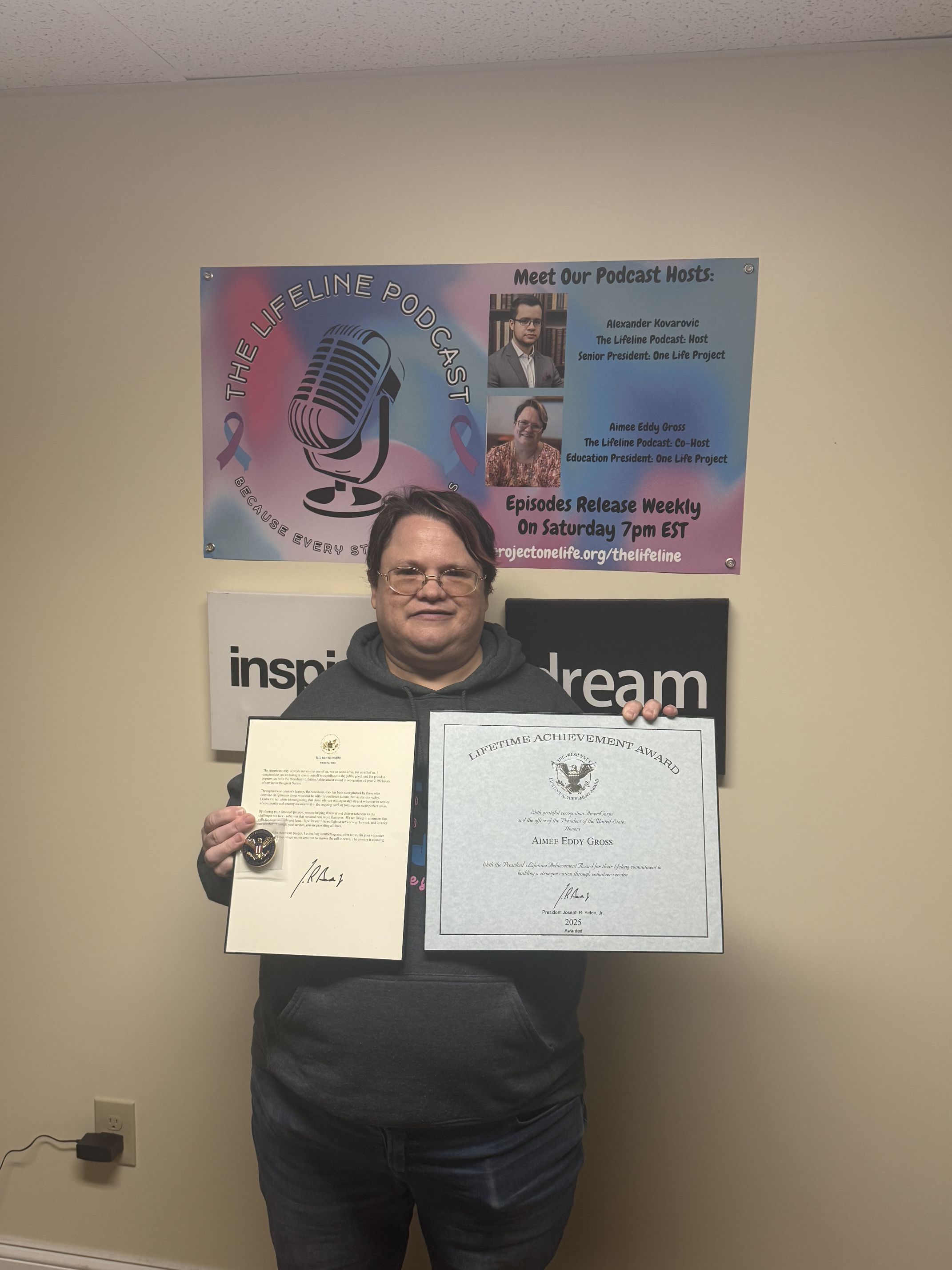
April 15 Alex picked up my husband and me up at our home and drove us five hours to Albany, New York, for an online conference for OLP. We spent the night in a hotel and the next day Alex drove us to OLP’s office in Massachusetts. In the office Alex recorded me giving a twenty-minute speech. He told me I did an excellent job. Then he presented me with five awards. He took pictures of me holding each award.

I was presented with the presidential Lifetime Achievement award signed by Joe Biden. I also received a letter from the president and a coin with an eagle on it.

Presidential Lifetime Achievement award signed by Joe Biden
Lifetime Achievement coin
Letter Signed by Joe Biden

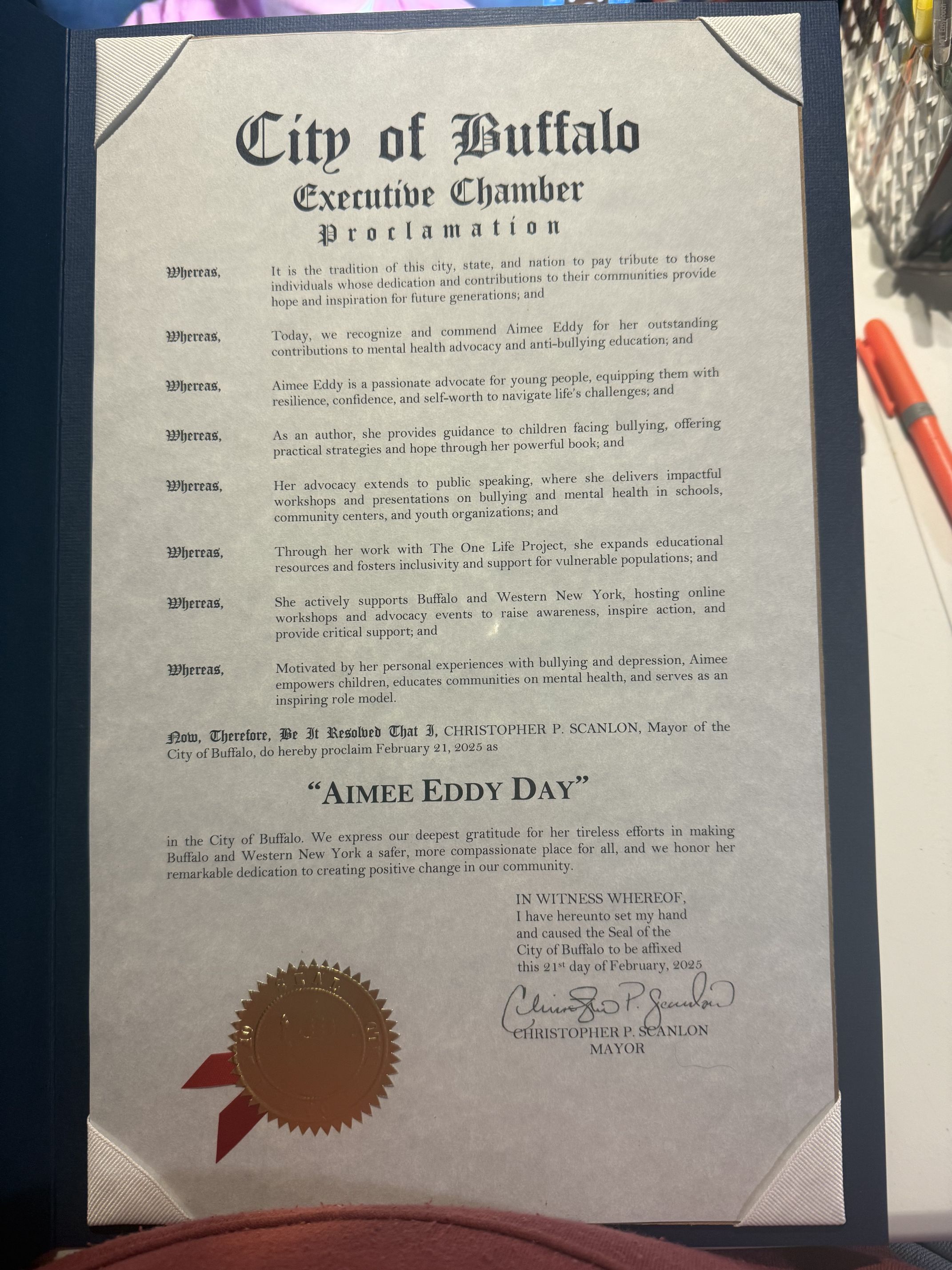
My next award was a proclamation from the mayor of Buffalo, NY, declaring February 21 “Aimee Eddy Day.”

Proclamation From Buffalo, NY’s mayor

Then I received The Guardian of Hope award from OLP.

One Life’s Guardian of Hope award

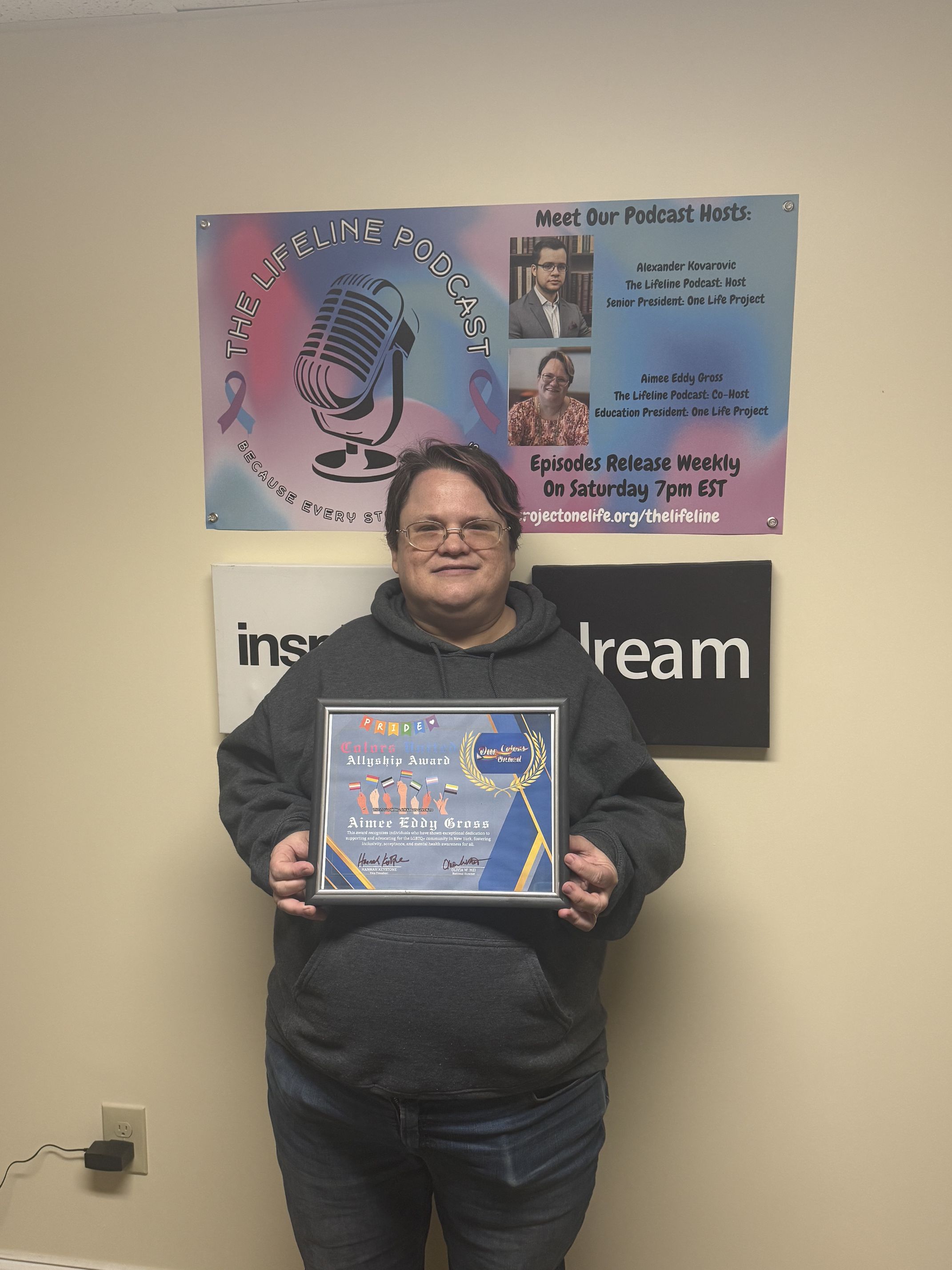
Next, I got Colors United Allyship award from New York City.

Colors United Allyship award

Finally, I was presented with the Community Health Heroes award from Massachusetts.

Community Health Heroes award

In school I dreamed of growing up and becoming successful, and now I have made that dream come true. The best award I get from doing work for OLP is helping others. I’m working to educate young people about mental illness so they can understand what this illness is and how to get help. When I was young, I didn’t know what was wrong with me or how to ask for help, so I struggled alone. I want to make sure no one else struggles like I did.

I wouldn’t be the executive president of education for OLP if Alex didn’t believe in me. He had faith in my abilities to be a leader even when I didn’t. It’s a new experience for me. I have always stayed in the background, following others and not stepping up or out. In school staying behind the scenes, not speaking, and following others were safe. If I was neither seen or heard, I could avoid some harassment. I no longer am hiding. I’m growing and becoming stronger. I’m leading a team of volunteers and even doing things I once hid from.

I’m proud of the work I am doing and how I have grown. Each award is a symbol of how I have risen up from my past and succeeded. They are also symbols of how proud I am to serve young people by educating them and advocating for them. I wish there had been a nonprofit like this when I was young. It’s important to me to help as many young people as possible.

I no longer think of myself as a failure for not attending a four-year college. The work I am doing now is very rewarding. I even love my job as a cashier. I love working with people. I touch people each day by smiling and giving them someone to talk to. You don’t need a big degree to be successful. By overcoming challenges in your life, growing as a person, and being determined you can be successful.

 I came home from our trip and hung my awards up on a wall in my home. I call it my wall of fame. Each time I look at those awards I see how much I have overcome and how far I have come. This helps me dance in the light of recovery.

ALL FEELINGS ARE VALID

We all experience life with different perceptions. We go through life’s struggles and each person’s journey is different. What may seem like a minor bad point in a person’s life may seem like a major one in another person’s life. Someone may feel sad about a situation, while another person may feel happy. No person on earth experiences life the same or feels the same emotions as another. Everyone’s feelings are valid even if we don’t feel the same or understand them.

Feelings are a tricky thing especially when it comes to mental illness. It is so hard to understand why a person with a good life could fall deep into sadness. It’s even more difficult to understand how a person could feel so hopeless and depressed that he or she would want to commit suicide.

A friend’s aunt came in my line at work. I told her that her nephew was really struggling with depression.

She looked at me and said, “What does he have to be depressed about?”

I was taken back by her response. It was like she couldn’t understand her nephew’s feelings of sadness. This happens a lot to people with mental illness. Many don’t understand those struggling and they shrug them off like their feelings are not important, when they are very important.

After my mastectomy I struggled with grief for the loss of my breasts. Many of my friends told me that I didn’t need them anyway and I should be happy they were gone. Some said they were envious of me and would love to get rid of theirs. I felt like they didn’t validate my feelings of grief and depression.  This made me feel even worse. It’s like my loss was a joke to them, and it wasn’t. I lost a part of my body, a part that made me a woman, and yes at times I wished I didn’t have them, but when it came to having them removed, it was like a piece of me was stolen from me. The hardest battle for me with breast cancer was dealing with my loss, and having friends who didn’t take my grief seriously made me feel even worse.

This has happened with my mental illness too. I had lived two years in recovery from mental illness. I had friends, I was living in an apartment with a friend, and I had a boyfriend. Then suddenly I fell down that hole of depression. I felt hopeless, depressed, useless, and worthless. Some people didn’t take my feelings seriously. It didn’t make sense to them that I would feel those emotions when it seemed like I had a good life. To them I had no reason to feel bad. This made me feel even more alone. The more my feelings were not taken seriously, the worse my depression got.

Years after I recovered from mental illness, I went to a friend’s house for a dinner. There was a group of us. They talked about a girl we all knew. The girl got upset and locked herself in the bathroom during a party. The girl told them her life was hopeless and she felt like she had nothing to live for. The group of girls who told me about it said that she was doing it for attention. They didn’t take her feelings seriously. They thought she was a joke when she was crying for help. To the girl her feelings were real and very overpowering. By locking herself in the bathroom and telling the group her feelings she was begging for help, and they didn’t listen. By not validating her feelings and noticing her call for help they made her feel more depressed, and she injured herself.

When I was in school there was a girl who kept talking about taking her life. I knew nothing about mental illness or that I was suffering with it. I thought she was telling us that for attention. She told me she was sad, and I thought she was a spoiled child craving attention. The teachers at my school never took her cries for help and feelings seriously either. She never got the help she needed because no one would listen to her or validate her feelings. I found out many years later she struggled with mental illness and was never able to get the proper help she needed. She has been living in an inner hell since she was a kid and it led to a very rough life.

     Everyone’s feelings are real and valid even if we don’t understand them or find a good reason for them. With mental illness the darkness, the feeling of hopelessness, the worthlessness, and inner anguish is very real. Not recognizing the person’s feelings and letting him or her know you acknowledge how they feel can be detrimental. It can lead a person deeper into his or her mental illness and can lead to suicide attempts or suicide.

When a person turns to you and tells you he or she is feeling depressed, that person is confiding in you and asking for help. Say you’re there for him or her, suggest he or she gets help, and listen to him or her. Don’t brush the person off or ask them, “What do you have to be depressed about?” Never assume the person is just trying to get attention. Don’t turn that person in to a joke you can talk about with your friends. Those feelings the person has been struggling with are very real, and if he or she is telling you about them then it is to ask you for help. Don’t ignore him or her. Validate his or her feelings.

Many years ago, when I confided in my mom my feelings, she went out of her way to get me help. Because people who care about me, friends, and family, validated my feelings, I got help and I dance in the light of recovery.