
ESTHER

In 2016 my husband and I went to the ANNA Shelter, a shelter for dogs and cats, to look at the dogs. Lou stopped to go to the bathroom and told me to go in and look around. I looked at the cages with dogs of all sizes inside. I stopped at a cage with a black dog with white on her paws, a strip of white stretching up from her nose, and white on her neck. I read the paper outside her cage saying her name was Esther and she was two years old. All the dogs in the shelter began barking except for Esther. It was like God whispered to me saying, “This is the dog for you.” I knew she had to be mine.

Lou came out of the bathroom. “Are you ready to look at the dogs?”

I pointed at Esther. “I want this dog.”

“But we haven’t gotten a chance to look at the other dogs,” he said.

“I don’t need to look. I must have this dog. Let’s see if we can take her in a room and hold her,” I said.
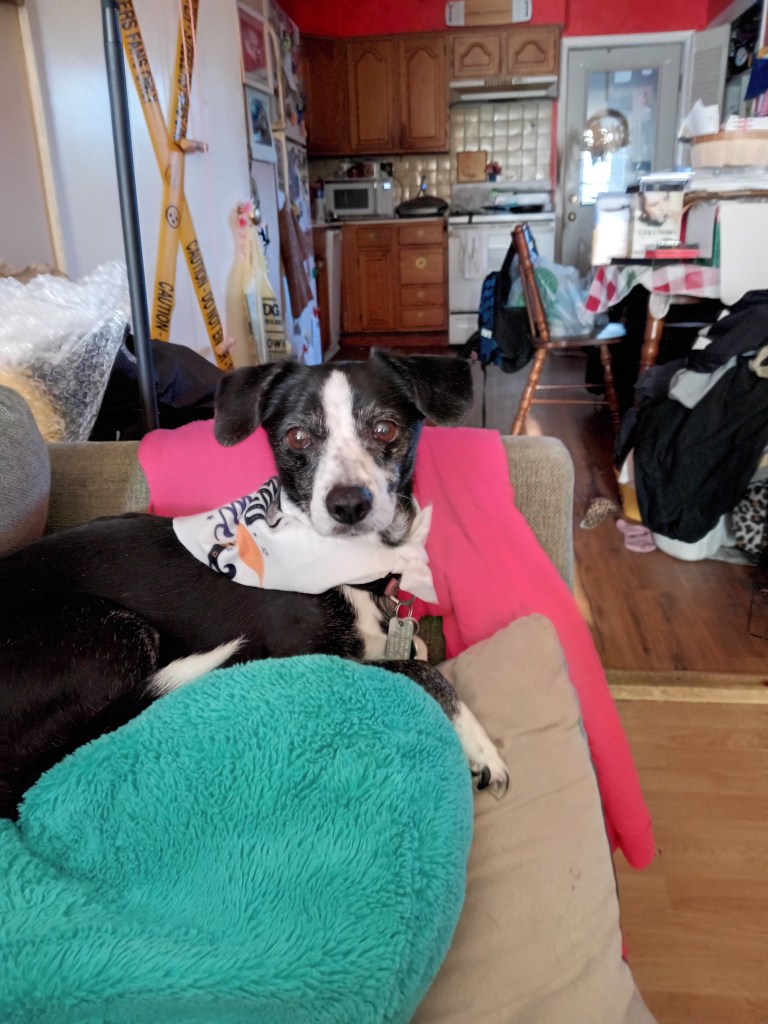
Lou reluctantly agreed. We took her in a room and I held her. I fell in love with her right away. When we brought her home that day, she clung to me. She didn’t want anything to do with Lou. Over several weeks Esther slowly started coming to him. In time she came to him easily, snuggling up on his chest. When Lou went down to watch TV in his mancave, Esther snuggled up on my lap as I stroked her ears and back. After a while she would go down and spend time with Lou.

Not too long after we got Esther, I had surgery on a torn tendon in my ankle. I was confined to the couch and used a walker to get around. Esther lay beside me and refused to leave my side. Lou had to pick her up and carry her outside to go potty, and he had to feed her on the couch. Through the years we had her I went through a bilateral mastectomy, hysterectomy, and back surgery. For each surgery she stayed at my side giving me comfort as I recovered.

Esther became more than just a dog; she became a comfort for surgeries and mental illness, and she became our baby, our child. Every time I got depressed and cried, Esther laid her head on my chest and looked up into my eyes. I’d bury my head in her fur and pet her. Her soft fur and head against my chest warmed my soul and brought light into my darkness. She knew what I needed and she gave it to me unconditionally.

She had her own anxiety. She didn’t like to be left alone while Lou and I worked. She made a mess out of the house. We had to put her in a crate while we were gone. The crate became her place of comfort. When Lou yelled at the Steelers game on the television, she retreated to her crate and she also went there when she got in trouble. She would even take her food there to eat it.
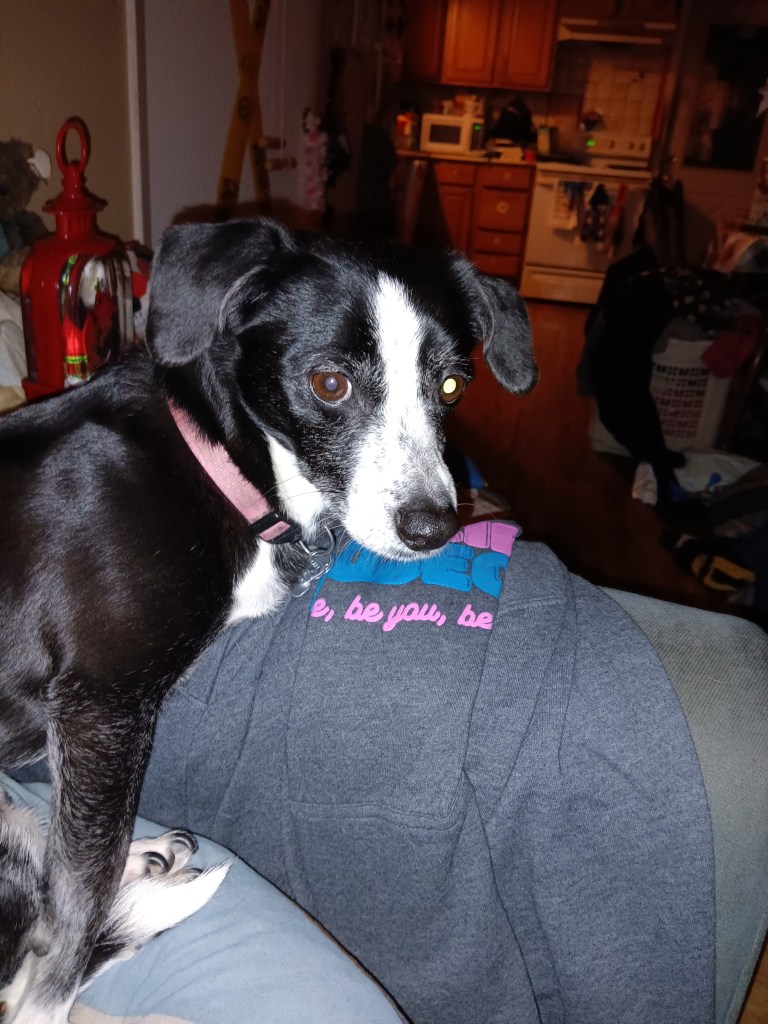
Esther barely ever barked. When she did, we were shocked. She was a very quiet dog. We knew where she was by the sound of her nails clicking on the floor and the jingle of her tags on her collar. She loved company. When people came to visit, she went up to them for attention. If we had more than one person visiting, she would go from lap to lap. She loved everyone except the mailman. When I took her for walks, she let the neighborhood kids pet her.

As she got older, she stopped sitting on my lap as much. She had arthritis in her left front leg. She started lying on the pillow I lay on when I’m resting on the couch. She would take up my whole pillow. So, I would gently rest my head on her and she was content. When my sister gave us a couch with back cushions you can move around, Esther crawled in between the cushions and the only thing you could see was her head. I would reach back and pet her.

Several months ago, I noticed a lump on her leg that was getting bigger. We took her to the vet and had it removed, but they couldn’t get it all because some of it was in her joint. I took care of her through her recovery. The vet said the lump was an aggressive cancer. Not too long after her surgery, another lump formed above the one that was partially removed. By Memorial Day her lump was open and seeping. It smelled bad. I took off from work that Tuesday to take her to the vet. Her leg was infected, leaving a hole that went to the bone. We could have had her leg removed, but the chances of her surviving and recovering were slim, or we could send her over the rainbow bridge. We couldn’t let her suffer.

The vet tech bandaged her leg up and sent her home with us for a few days. We fed her fries, ice cream, spaghetti, and eggs. We hugged her, petted her, and gave her all the love we could before taking her back to the vet on Friday. I held her tightly to my chest as the vet administered the medicine and she drifted away. I laid my head on her head and wept. Tears caressed Lou’s eyes too as he also said his goodbyes.

Now Lou and I both grieve Esther. She gave us endless love for nine and a half years. She gave us comfort. Lou found comfort in her with his illness and while he was home alone while I worked. Now our lives seem empty and sad. Esther will always have a place in our hearts. She was our therapy dog, our companion, our best friend, and our baby.

We are taking each day at time as we grieve Esther’s loss. In time we’ll get another dog, but right now our hearts have to heal. Memories of my baby girl keep me hanging on to the light of recovery.


CAUSES OF STRESS

We all deal with stress in our lives. It’s all around us. When we struggle with mental illness, stress seems like a huge cloud hanging over us, threatening to throw us deeper into our hole. To handle that stress, we must first identify the things in our lives that cause stress. Knowing what causes you stress will help you find ways to avoid them and ways to cope with them.

I talked to my therapist about the things in my life that are causing me stress, and then we talked about how to cope with them.

Below is a list of things that cause stress.

  • Finances. With the cost-of-living, money is a big stressor in many people’s lives. Coming up with a budget and keeping to that budget is helpful. Look for ways to save money. Focus on the bills you can pay and work out payment plans for ones you can’t pay. Don’t dwell on not having enough money. Only focus on what you do have.
  • Relationships. Bad and unstable relationships cause a lot of stress. Take steps to end unhealthy relationships or go to therapy to work on them. Look for healthy and positive relationships.
  • Health problems. Having a lot of health problems is hard to handle and stressful. Focus on what you can do for your health, and don’t worry about what you can’t do or the future. Like if you have diabetes, focus on the medication and changing your food habits, but don’t worry about the health problems diabetes can cause.
  • Work. Working can be stressful. Know your limits. If working is too stressful for you then find other alternatives like filing for disability. If working full-time causes a lot of stress, then find a part-time job. I work part-time because working forty-hour weeks is too stressful for me. If you get stressed out at work, practice relaxation techniques or take a break if possible.
  • Death. Losing a loved one, whether it’s a family member or a friend is very stressful and can cause depression. Allow yourself to grieve, use coping techniques to deal with depression, and take care of yourself. If you have a lot of decisions to make, take your time and if possible, delegate decisions to other family members or friends.
  • Care giving. Taking care of a loved one who is sick is very stressful. Make sure you take care of yourself. Get someone to stay with your loved one while you take some time for yourself. Get help from friends, family, and in home-care agencies.
  • Change. Moving, starting a new job, and other forms of change can be stressful. Find ways to cope with change and allow yourself time to get used to it.
  • Traumatic events. Natural disasters, rape, abuse, and so on are very stressful. Look for a therapist to help you cope with the trauma. Give yourself time to heal. Journal about what you went through. Use art to get your feelings out.

These are only a few things that cause stress. Stress can make fighting mental illness harder. If we identify what causes us stress and find ways to cope with them or avoid them, it will help us reach recovery or stay in recovery. With mental illness you need to know your limits and use boundaries to protect your mental health. On a piece of paper list the things in your life that currently cause you stress. Then come up with a plan on how to cope with them or, if you can, avoid them.

Right now, I’m dealing with a lot of stress in my life: a sick loved one, a dog recovering from surgery, finances, and a badly bruised thumb. My therapist told me to practice self-care and to focus on the things I can change and let go of the things I can’t change. By doing this I stand in the light of recovery.

CHRISTMAS JOY

A holiday, especially at Christmas, can be a very hard time for people. There are the stresses of buying gifts, preparing a meal, family get-togethers, and family drama. Some people are struggling with grief, mental illness, and loneliness. All these can make Christmas seem unbearable. How do you make it through the holidays if you’re struggling with these things? Do you lie in bed and ignore the holidays?

I used to find the holidays unbearable. I had loving parents and grandparents, but I felt alone. I was struggling with depression and didn’t know it. While everyone was excited about Christmas, I was dying inside. Everything seemed dark and hopeless. I couldn’t find the Christmas spirit. Instead of smiling and laughing with my siblings, I was grumpy and easily got mad or irritated. I’d lash out in anger when someone was just joking with me. I was a miserable person to be around. My parents couldn’t understand why I hated holidays. I even felt like I was alone among family at my grandparents. I wanted to hide from everyone.

When I got older and started going to therapy, I learned to cope with the holidays. I learned to find the positive side to holidays. I learned Christmas isn’t about the material gifts, but gifts from the heart. As a teen I woodburned gifts for my parents and grandparents. Even now that I’m an adult I woodburn gifts for friends and family. If I feel alone among family, I find one person I can confide in and talk to. When I feel hopeless, I list the things I’m grateful for. When I feel depressed, I journal out my feelings or turn to my support system.

This year I have been teetering on the edge of the hole of depression. 2024 has been rough and we have been struggling financially. I’ve been trying to help my husband find a job. I keep myself busy by wooodburing gifts, I‘ve been leaning on my support system and listing the positive things in my life. Unemployment claims my husband is working when he’s actually not and has paused his unemployment benefits until further review. We are pinching pennies, and everything seems hopeless but it’s not. Many positive things have happened: My parents help us when they can; a co-worker is gave us half a ham and we got a lot of food from the food bank. We even had some extra canned foods to give to an elderly lady in our neighborhood. We also received a check from one of my customers, and we used it to get each other a few gifts. We’re also blessed to have have a warm home.

I love it when my husband spoils me with gifts and I love to spoil him too, but we can’t do much of that this year. Christmas isn’t about celebrating with family, buying gifts, or eating big meals. Christmas is about the gift God gave us, his Son. We don’t need money to celebrate Jesus’s birthday. We just need to have the Holy Spirit in our hearts and love of Jesus and God in our souls. Money can’t buy that. If you have those then you don’t need family, gifts or food to enjoy Christmas.

You can share the love of God by smiling, saying a kind word, giving a hug, or dressing for the season. I dress up in holiday shirts and hats at work. I have one hat with Santa’s feet at the top like Santa got caught in a chimney on my head. It puts a smile on my customers’ faces, some giggle and it eases the stress of holiday shopping. I smile with the love of God in me and my customers love that. When you give a gift from the heart, then you are giving the true gift of Christmas. God gave us the gift of his Son, from his heart.

If you’re struggling this Christmas, find ways to cope, leave family get togethers when they become too much, or list memories of your loved one. If you’re alone, celebrate Jesus’s birthday by lighting a candle and eating something special. Find the joy of Christmas in your soul by thanking God for his gift by giving a gift from the heart. A few customers told me they had no family so Christmas is just another day, but it’s not. It’s a special day and you can celebrate without family. You can pray to God, sing “Happy Birthday” to Jesus, make a special meal for yourself, or find a place offering Christmas dinners to go eat.

Despite a rough year and lots of stress, I’m celebrating Christmas with a smile on my face and God in my soul. This Christmas my soul will shine bright in God’s love while I celebrate in the light of recovery. Merry Christmas!!!

FACING A ROUGH TIME

Cancer has affected almost everyone’s life in some way or another, whether it be a friend, co-worker, family member, or your own journey. Cancer likes to rear its ugly head and leave a wound or scar on the soul. It’s hard to face going through your own cancer and then face it again with a loved one. When you have depression and anxiety, facing hardships like this can deepen your illness or send you down that dark hole again.

When my grandpa got prostate cancer many years ago, they said he’d die of natural causes before he’d die of cancer. The sad thing is the cancer spread throughout his body and he struggled to the end. I kept breaking down so much when I went to see him in the hospital that I couldn’t go see him anymore.

Then when I learned I had breast cancer, my thoughts went back to my grandpa and I thought I was also going to die a miserable death, but I didn’t. I’m still here, proud to be a survivor.

I prayed cancer would never affect our family again, but it has. After a week long vacation, my husband and I came home to the news that my dad has bone cancer. I put on a brave face on for my parents, but when I got home, I broke down. I cried in Lou’s arms. Then in the days after the announcement, I went from okay to falling apart. It became a matter of waiting to see when they would start chemo and the next steps. I didn’t have to go through chemo when I had cancer, but there was a lot of dreaded waiting. Waiting to find out if I had the BRCA gene, waiting to find out what was next, and wondering what was going to happen to me. All those memories returned with my dad. The old emotions and fears resurfaced.

My dad is a handy man and a mechanic. He can fix almost anything. He fixes cars, lawn mowers, and even private airplanes. He has fixed and still fixes many of my vehicles. He does repairs around his own home, has helped remodel his church and has done repairs in my home. If he’s sitting down too long, he thinks he’s being lazy. He gives from the bottom of his heart to his family, friends, and strangers. I don’t always agree on his views, but I love him endlessly. Hearing he has bone cancer sent a knife deep in my heart.

My father has always been a healthy, active man even at seventy-four. Nothing kept him down. His oncologist said his cancer wasn’t life threatening, but they said something similar about Grandpa’s. I can’t bear the thought of losing my dad from a miserable struggle with this horrible disease. This troubled me greatly. I don’t want to lose my dad. I cried more tears in Lou’s arms.

Then my dad had to take a class about his treatment and start shots and chemo. My younger sister came to town to go to appointments with them. I was relieved but I felt guilty. I stress every six months when I go to the cancer center for my checkups, but going there for my dad seemed even more frightening. I just couldn’t do it, but I felt it was my responsibility. My older sister is struggling with health problems, and as the second oldest I should be at my parents’ side while my dad goes through his treatments, but emotionally I can’t handle it.

I remember making the decision to have a double mastectomy and then a full hysterectomy. I cried about it and agonized over it. Then there was the news that I would have to wait six months to do reconstruction and it would take several surgeries for it. I decided not to do reconstruction, and I had to learn to love myself as a woman without breasts. I felt like I was getting one let down one after another. My whole life was changing, and I fell into a depression. Those feelings came back as my dad faced his treatments.

When my sister told me the details of my dad’s treatments, I realized my dad’s life would be forever changed. His food had to be washed before being prepared, masks in public, washing his hands frequently, being susceptible to illnesses, and chemo every day. I felt that anguish inside me like the anguish I felt when I had cancer.

Then as we came closer to the beginning of his treatments, I began to worry obsessively how chemo would affect him. Would he no longer be that active and strong man I always knew? Would he get very sick? Would he need lots of extra care? The worries flooded me, and I felt the sadness of depression taking control. My muscles were tense, my stomach twisted, and the tears came expectantly. I struggled to sleep or even focus on everyday things.

When he made it through his first shots and chemo pill without many problems, I sighed with relief. Now I worry about him catching an illness and ending up in the hospital. I worry about my dad having more side effects from the chemo pill the longer he takes it. The worries flood my mind and I feel like I’m losing control of my illness. I feel the pain of my emotions searing throughout my soul. The tears, the endless worries, and my chest tightening has me struggling to hold on to the edge of my hole. I feel like I’m losing control, and I will be at the bottom of that hole again.

I remind myself this is just a rough time, and I can get back to the top of the hole again. I lean on my support system, I journal my feelings, and I plan to work on some woodburning projects and my next book. I talked to my psychiatrist about my struggles with my depression during this rough time, and he upped my medicine.

Rough times are part of recovery from mental illness and part of the struggle with this sickness. The important part of dealing with rough times is using coping techniques, leaning on your support team, and asking for extra help from your therapist or psychiatrist. There will always be bad things happening in our lives, threatening to make the struggle with or recovery from mental illness rougher, but the most important thing is how you handle it. Don’t let it destroy you or throw you down that hole again. You can get through life’s heartaches and still work towards recovery or stay in recovery.

My dad’s journey has just begun and what is to come is unknown. Our hopes are that he will reach recovery. My struggles with this rough time will take a lot of work and coping, but I will soon stand in the light of recovery again.

DEPRESSION WITH GRIEF

When a person loses someone close to him or faces any kind of loss, he goes through five stages of grief. One of the stages of grief is depression. No matter what kind of depression you have, whether it be because of mental illness or grief, it is something that should be taken seriously. If you already have depression due to mental illness grief can intensify it. When it is depression from grief, it can be handled differently than that caused by mental illness.

I have gone through a lot of grief in my life. I went through the five stages of grief, but when it came to depression, it was intensified for me. When I lost my uncle in an accident, I was already suffering with depression. The loss intensified my depression and sent me into a very dark place. I fell to pieces and was on the edge of my breaking point. My thinking was illogical and internally I blamed myself for his death because of a wish I made. I didn’t know the difference between depression because of grief and the depression I already was feeling. I didn’t even know what depression was at that time.

Each time I have lost people in my life, it intensified my mental illness. In therapy I learned different ways to cope with depression as a mental illness. Recently I learned that dealing with a person who is suffering with depression just caused by grief is different than handling a mental illness.

A dear friend of mine lost a very close family member. Her family member had been ill, and as she took care of him, she started dealing with stages of grief. When he passed, she sunk into a depression. I wanted to be supportive, and I thought I could help her by sharing some of my coping techniques I learned for depression. She didn’t respond to my suggestions. I decided to do some research.

Here is a list of things you can do to help your friend or family member suffering from depression due to grief:

  • Don’t tell them about your grief or depression experiences. When a person is grieving, he can only focus on what he or she has lost. Grieving people don’t want to hear your experiences.
  • Don’t give advice. Don’t tell people what they should do with their grief or what worked for you. Don’t tell them how you think they should deal with their depression. You could do more harm to them. Everyone grieves differently. Allow your friend or family member grieve in his or her own way.
  • Be willing to listen and be supportive. This is when your friend or family member needs you the most. Be available to listen, to comfort, and to give support when they need it.
  • Don’t get pushy. If your friend or family member pulls away and insists he needs time alone, let him have that time. Don’t insist on visiting, on getting him out of the house, or talking when he is not ready to. If your friend or family member is sleeping a lot and doesn’t have interest in everyday activities, don’t push him. Let the person come to you when he or she is ready.
  • Do little things to remind the friend or family you are there for him or her. Offer to get the person’s mail, send a thinking of you card, or bring the person a meal.
  • Check in on your friend or family member. If your friend is spending a lot of time isolated from everyone, check in with him. Give him a phone call or drop in just to make sure he is well. You don’t have to stay to visit or have a long conversation. Just make sure the person is okay and then let him or her be.
  • Give your friend or family member plenty of time to grieve. Some get over grief in a short time and others may take longer. Never tell him or her to get over it. Let him take as long as he needs to grieve. Just support the person, no matter how long it takes.
  • Don’t avoid talking about the loved one your friend or family member lost. He needs to be reminded of the good memories and to share his own memories. Talking about the person he lost helps him come to terms with his loss.
  • Beware of signs your family member or friend needs extra help. If your family member or friend stops functioning, talks about suicide, gives up on taking care of himself, and the depression worsens, suggest grief counseling or therapy.

Grief is a hard thing to go though and sometimes we fear we’ll say or do the wrong thing when trying our best to help a loved one who is grieving. The best thing we can do for a person grieving is to be supportive and patient.

Because I researched grief I am working to be as supportive as I can be for my friend. Being there for others in their time of need and learning about depression from grief helps me stand in the light of recovery with a full heart and new knowledge.