CHRISTMAS JOY

A holiday, especially at Christmas, can be a very hard time for people. There are the stresses of buying gifts, preparing a meal, family get-togethers, and family drama. Some people are struggling with grief, mental illness, and loneliness. All these can make Christmas seem unbearable. How do you make it through the holidays if you’re struggling with these things? Do you lie in bed and ignore the holidays?

I used to find the holidays unbearable. I had loving parents and grandparents, but I felt alone. I was struggling with depression and didn’t know it. While everyone was excited about Christmas, I was dying inside. Everything seemed dark and hopeless. I couldn’t find the Christmas spirit. Instead of smiling and laughing with my siblings, I was grumpy and easily got mad or irritated. I’d lash out in anger when someone was just joking with me. I was a miserable person to be around. My parents couldn’t understand why I hated holidays. I even felt like I was alone among family at my grandparents. I wanted to hide from everyone.

When I got older and started going to therapy, I learned to cope with the holidays. I learned to find the positive side to holidays. I learned Christmas isn’t about the material gifts, but gifts from the heart. As a teen I woodburned gifts for my parents and grandparents. Even now that I’m an adult I woodburn gifts for friends and family. If I feel alone among family, I find one person I can confide in and talk to. When I feel hopeless, I list the things I’m grateful for. When I feel depressed, I journal out my feelings or turn to my support system.

This year I have been teetering on the edge of the hole of depression. 2024 has been rough and we have been struggling financially. I’ve been trying to help my husband find a job. I keep myself busy by wooodburing gifts, I‘ve been leaning on my support system and listing the positive things in my life. Unemployment claims my husband is working when he’s actually not and has paused his unemployment benefits until further review. We are pinching pennies, and everything seems hopeless but it’s not. Many positive things have happened: My parents help us when they can; a co-worker is gave us half a ham and we got a lot of food from the food bank. We even had some extra canned foods to give to an elderly lady in our neighborhood. We also received a check from one of my customers, and we used it to get each other a few gifts. We’re also blessed to have have a warm home.

I love it when my husband spoils me with gifts and I love to spoil him too, but we can’t do much of that this year. Christmas isn’t about celebrating with family, buying gifts, or eating big meals. Christmas is about the gift God gave us, his Son. We don’t need money to celebrate Jesus’s birthday. We just need to have the Holy Spirit in our hearts and love of Jesus and God in our souls. Money can’t buy that. If you have those then you don’t need family, gifts or food to enjoy Christmas.

You can share the love of God by smiling, saying a kind word, giving a hug, or dressing for the season. I dress up in holiday shirts and hats at work. I have one hat with Santa’s feet at the top like Santa got caught in a chimney on my head. It puts a smile on my customers’ faces, some giggle and it eases the stress of holiday shopping. I smile with the love of God in me and my customers love that. When you give a gift from the heart, then you are giving the true gift of Christmas. God gave us the gift of his Son, from his heart.

If you’re struggling this Christmas, find ways to cope, leave family get togethers when they become too much, or list memories of your loved one. If you’re alone, celebrate Jesus’s birthday by lighting a candle and eating something special. Find the joy of Christmas in your soul by thanking God for his gift by giving a gift from the heart. A few customers told me they had no family so Christmas is just another day, but it’s not. It’s a special day and you can celebrate without family. You can pray to God, sing “Happy Birthday” to Jesus, make a special meal for yourself, or find a place offering Christmas dinners to go eat.

Despite a rough year and lots of stress, I’m celebrating Christmas with a smile on my face and God in my soul. This Christmas my soul will shine bright in God’s love while I celebrate in the light of recovery. Merry Christmas!!!

SNOWAGEDDON AND DRAMA

Living by one of the great lakes, Lake Erie, makes weather in Erie PA and the regions nearby unpredictable. In 2017 we had nearly five feet of snow dumped on us on Christmas day, and my husband and I were stranded over night at my parents. Over the past few years, we have been lucky and had mild winters. I hoped this year would be easy too, but the unpredictable lake had other plans for us.

Thanksgiving Day was a clear and calm day. Then I woke up Friday morning to snow falling like God was dumping it from heaven in truck loads. My husband, Lou, was supposed to have an interview that afternoon. He drove me to work in slim visibility. I told him not to go to the interview and try to call them instead. I started work while he attempted to call, but he just got an answering machine. He then left to go home. I cashed out customers and Lou came to me upset. The vehicle would not start, and alarms were going off.

I handed a customer a bag of groceries and turned to my husband. “Maybe the steering wheel is locked. Try moving it around.”

For an hour Lou was in and out of the store trying everything he could think of to get our SUV to start. He came to me upset and soaked. Since I was working, I couldn’t help him. I told him to stay inside and dry off in the café until I got my break. When I got my break, we both went out to our SUV. This time we couldn’t open the doors. We went inside and I tried to call a few garages, but  I only got answering machines. The snow just kept coming down, so I told Lou to just relax in the café until I got off work.

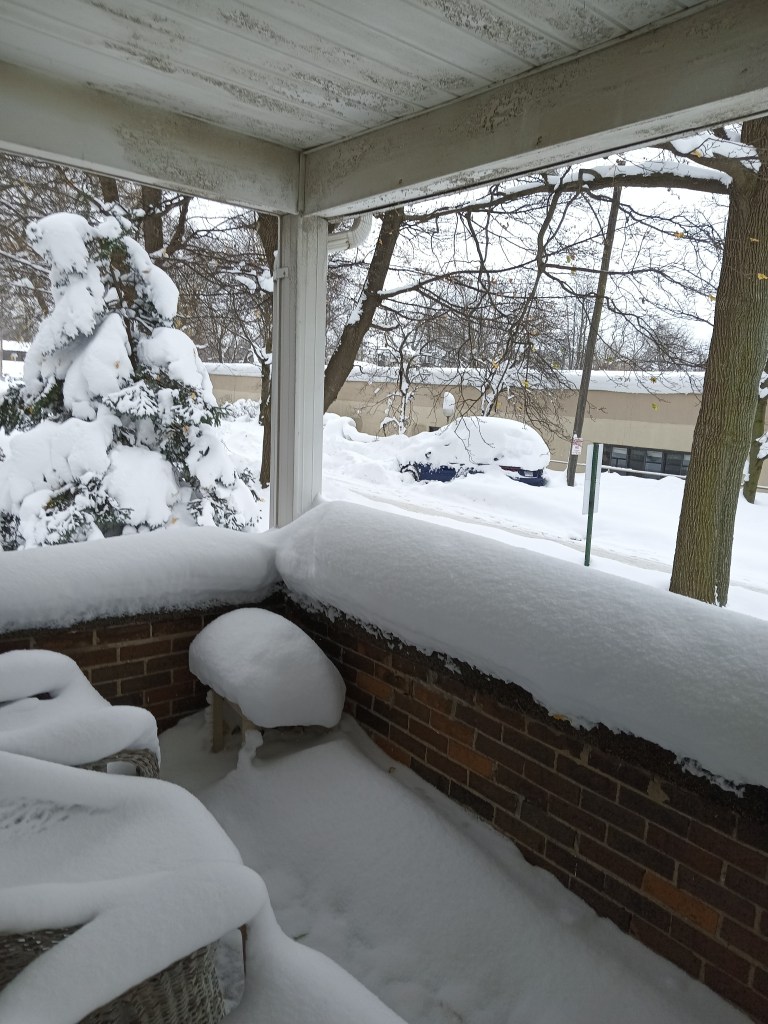
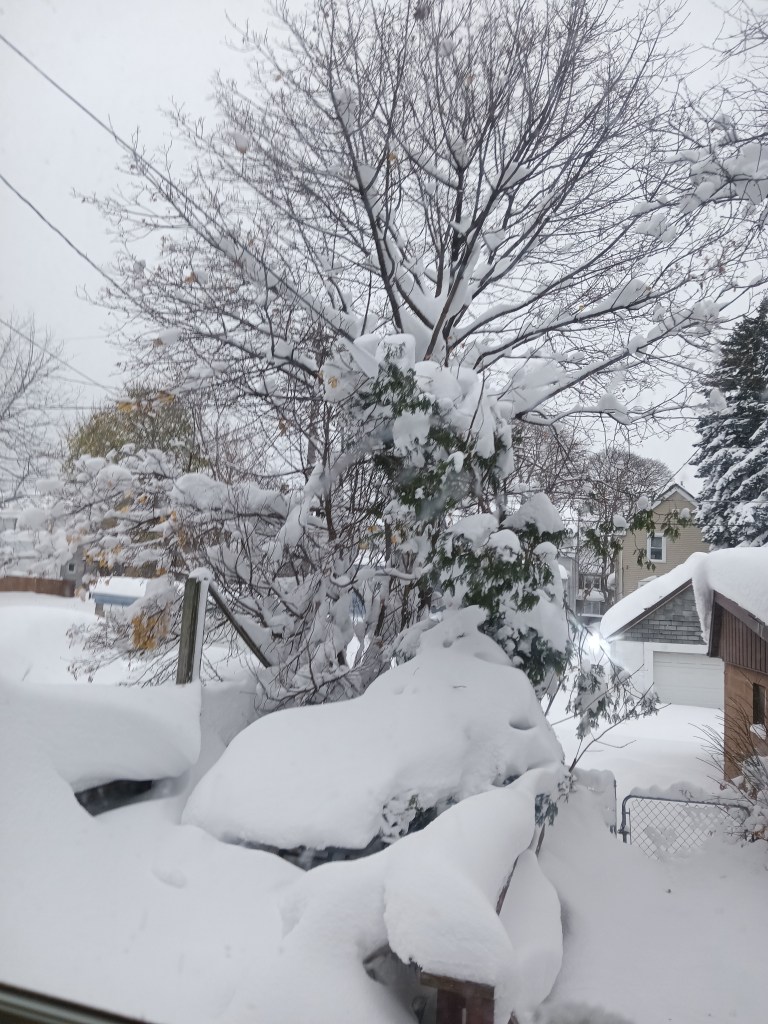
Fifteen minutes before my shift ended Lou found a friend to take us home. My boss let me go early. He drove us to the end of our road, but the snow was so deep that cars were stuck in the road. We had to walk up a block to our home wile snow pounded us in the face. We only had the back door key, but our neighbor had the sidewalk to the front shoveled. We live in a row house, which is like a condominium. One side we are attached to a block of row houses, and on the other we have a small fenced in yard. On the other side of the fences was a long row of more houses. The yard was too deep to walk through and the alley where we usually park our cars was unplowed. Our neighbor let me walk through their house to the back. I waded through snow past my knees to our driveway. I pulled the gate to our fence, opened it a little, and squeezed through. I waded through more snow until I got on our deck and into the house. I let Lou in the front door.

Our front porch.

The next two days I was off work. I didn’t leave the house on Saturday and on Sunday my neighbor took me to the store to get a few things. The snow continued to pile up. I binged on Netflix, worked on workbooks for One Life Project, texted with my friends, and watched Christmas movies with my husband. We watched the news to find that they declared a snow emergency for Erie and called in the National Guard. People were stranded on the major highways and warming centers were being put in place.

Monday it stopped snowing during the day, but the roads were bad. Buses were canceled so I called off work. I had no way of getting there. My dad traveled from Ripley NY, a half hour away for his treatment at the cancer center. Afterwards he tried to get our vehicle started with no luck. My parents took us back to Ripley with them and my dad lent us his pickup. It was nice to have a vehicle to drive, but since I’m short, getting into my dad’s pickup was like climbing a mountain. Getting out I had to slide off the edge of the seat until I reached the ground.

The next day my dad had our vehicle towed. On Wednesday he told us to bring our spare key fob because the one we were using was causing our car problems. That night we drove our car home. The next day when we tried to start it, it wouldn’t start again. We tried to go back in the house, but I had accidentally locked us out. I had a spare key for the back door. So once again, we went through our neighbor’s house to the back of the house. This time the snow was waist deep, and we had to use our neighbor’s shovel to remove snow from around the gate in order for me to squeeze through. I got in the house and let my husband in the front door. We called my dad and spent the rest of the day at home.

Our back yard and porch that I had to wade through

The next morning my parents came so my dad could check the battery in our car. The battery was dead. My dad dropped me off at work and went and got a battery. When my husband showed up for my break, I knew our SUV was running again.

For that whole week it snowed each night, adding to the snow total and back roads became narrower and narrower. The snowplows ran tirelessly, but there was no place to put the snow. By Tuesday the following week customers were starting to dig themselves out and were filling the aisles of the grocery stores. By Friday the news said we had a little over four feet of snow.

I could have gotten down and depressed with our situation, but instead I kept myself busy. I was stressed and frustrated with our car problems, but my dad, our hero, came to our rescue. We were in a bad situation, but as my friend Amy always says, “God will provide,” and he did. Each time I started to worry I texted a friend or found something to do. I kind of liked my two days off from work and away from reality. We were nice and warm in our home.

If you are feeling trapped by the winter weather and dealing with problems you can’t control, turn to your support system, find things to keep you busy, pamper yourself, and find ways to relax. Life throws us in a snowbank sometimes, and it’s up to us to dig ourselves out and to cope.

Next week they are predicting warmer temperatures and rain. We might be swimming our way around Erie. I stayed strong through our drama and because of that I am dancing in the light of recovery.

BEING THANKFUL

The holidays are supposed to be a happy time of year. Thanksgiving is getting closer and closer. People are busy planning big meals to celebrate with friends and family. It’s a time of sharing and being grateful for the things we have in our lives. But for many this holiday and other holidays are dreaded. Some struggle with anxiety about spending time with large groups of people, some are alone, some are struggling with depression and can’t find joy, some dread family drama, and some are spending the holidays without a loved one.

When I was younger, I hated holidays. They only made me feel more alone and depressed. I struggled with friends coming in and out of my life. My classmates and teachers put me down. I felt even more isolated from the world during the holidays. Thanksgiving left me feeling like there was nothing in my life to be thankful for. I fell into a depression and became irritable at the holidays. I fought with my siblings and easily went off on my parents.

When I met my husband, my perspective on holidays changed. He made everything brighter. He gave me reasons to celebrate, and with him I never feel or felt alone. I found things to be thankful for at Thanksgiving time.

This holiday season my husband and I are struggling financially, and I’m helping him search for a job. I feel stressed, sad, and overwhelmed. Thanksgiving is Thursday, and I have been wondering what I have to be thankful for. My husband is out of work, bills are adding up, we’re applying for jobs for him, but no one is calling, we have big decisions to make, and I don’t know how to make them. I feel depression tugging at me, but I’m fighting it.

To get into the holiday spirit I decided to write a list of things I’m thankful for. Here is my list:

  • I’m thankful for friends who have helped my husband and me in our time of need. A customer who has become a friend sent me a check, a friend brought us dog food and a gift card, and another friend gave us a turkey breast.
  • I’m thankful to have a house to live in. Despite how tough things are for us, we still have a roof over our heads.
  • I’m thankful for my husband. I wouldn’t want to go through these tough times with anyone else.
  • I’m thankful for my parents. My parents are always giving moral support, listening to us, and helping us out in anyway they can. Their love is endless.
  • I’m thankful for the food bank at our church. Without the food bank, we would not have food.
  • I’m thankful for my dog, Esther. She always seems to know when I’m struggling, and she gives me extra cuddles.
  • I’m thankful for being strong enough to fight depression. I could easily fall to the bottom of my hole of darkness, but I refuse to let that happen.
  • I’m thankful for having a family that loves me. My parents are wonderful, and so are my siblings. They show me in different ways how much they care.
  • I’m thankful for my job. Without my job, we would be in even worse shape. Talking to my customers brightens my day.

Thanksgiving is a time to look at your life and see what you have to be grateful for. When you are struggling with hard times and mental illness, it’s hard to find good things. If you think about it and list things you are thankful for, you might find light in your soul. You can be grateful for small things like getting out of bed, taking a shower, or going for a walk. No matter how bad things seem, there is always something in your life to be thankful for.

This holiday season I have been struggling with a lot of emotions and coping to keep above the hole, but writing a list of what I am thankful for is helping me celebrate in the light of recovery.

COPING WITH STRESS

Stress causes physical and mental health problems such as stomach issues, weakened immune system, high blood pressure, tense muscles causing aches and pain, depression, and anxiety. We all deal with some type of stress in our lives, but when you have mental illness stress can make your illness worse. With mental illness minor things can stress you out and it can lead to self-injury, anxiety attacks, and suicide attempts.

The important thing is to know how to cope with stress so that you can reach towards the light of recovery or stay in the light of recovery. Here are some coping techniques I learned to deal with stress:

  • Identify your trigger. What types of things cause you to be stressed? Could it be dealing with family problems, could it be taking on too much responsibility, could it be making important decisions, or working long hours? List your triggers in a journal or on a sheet of paper. I keep a list of my triggers in my journal.
  • Reduce your to-do list. If you are doing too much, then cut your list down. See what is most important for you to complete, and leave the other things for another time. If work stresses you out, then determine if you need a different job or if you can reduce the number of hours you work. I work part time because working full time is too stressful for me and causes my anxiety to heighten.
  • Practice relaxation. Find something to do that relaxes you such as listening to music, deep breathing, trying yoga, practicing mindfulness, taking a bath, going for a walk, or doing a craft. Everyone has different ways or things they do that help them relax. Find something that works for you. I find woodburning, imagining lying on a beach, and deep breathing relaxing.
  • Turn to your support system. If you don’t have a support system, build one. Having friends and family that support you is very helpful with your mental illness and dealing with stress. If you’re feeling stressed, talk to someone in your support system, make plans to meet for lunch, send a text or invite them over. Leaning on others who can encourage you, listen to you, and who can help you see a different perspective will help you handle your feelings and stress better. When I’m stressed out, I lean on my husband and friends. My friend, Cheryl, and my husband always help me see things in a different way and find away to get me to laugh.
  • Ask for help. If you can’t deal with your stress on your own, consider going to therapy. A therapist can work with you on different coping techniques that will help you. If you are taking too much on, then ask a friend or family member to help you out. If you are making a decision that stresses you out ask someone to guide you with that decision. If you have too much to do, then ask a family member or friend to help you get it done. There is nothing wrong with asking for help. When I have problems with making a decision, I ask my husband for help, and when I have too much to do, I ask my husband to help me out.
  • Know your limits. Know how much you can handle before you get stressed out. Once you know your limits, stick to them. If a friend asks you to put together a baby shower for her and it pushes past your limits, kindly tell your friend you can’t do it. If working two jobs is too much, then just work one. If everyone is asking you to do something for them and it causes you stress, then only take on what you feel comfortable with and tell the others no. There is nothing wrong with limiting how much you do for your own wellbeing. I only do as much as I feel comfortable with. If it is more than I can handle, then I tell people no or I do less.
  • Take care of yourself. If you take care of your physical and mental health, you will be able to handle stress better. Get plenty of sleep, eat well, practice coping techniques, take your medicine, and pamper yourself when you need to. When I’m stressed it is easy to skip a meal or lose sleep by worrying too much. I try to journal out my worries before bed, and I make sure I eat three meals a day. If I’m worrying too much and can’t sleep, I talk to my husband, and he helps me talk things out so I can sleep.
  • Challenge your negative thoughts and practice positive thinking. If you’re thinking negative things, turn them into positive thoughts. Try to practice positive thinking to keep your spirits up. Bad thoughts only bring you down and make you feel hopeless. I journal out my negative thoughts and then change them to positive ones. When I’m negative, my husband reminds me to be positive. I notice when I focus on the positive, I feel better.

When stress starts to drag you down that dark hole, practice these coping techniques. Don’t let stress cause you physical health problems and worsen your mental health. You are important and it’s important to know how to take care of yourself by managing your stress with coping techniques. Sometimes there is stress in your life you just can’t avoid, but by coping with it you can handle it better.

By managing my stress, I relax in the light of recovery.

LIFE’S ROADBLOCKS

“Give it to God and all your anxiety and stress will ease,” they tell me. I lie in my bed at night praying really hard for my worries to ease, my inner pain to go away, and for strength, but I feel no better. Is it because I’m not a good Christian, am I not praying the right way, or have I lost my connection with God? With mental illness it’s very hard to just let go of stress and anxiety, especially when life is putting up so many roadblocks. Praying doesn’t just take away my racing thoughts, anguish, tense muscles, and upset stomach. My mind won’t stop.

Life has been a challenge for a couple years since my husband’s workplace started remodeling. I held on to the hope that once the remodeling was done, he would be back to his full-time hours, and we would be on our feet again. Then when the remodeling ended, my husband got his hours back for a short time, but suddenly they cut him down to two days a week. He got unemployment, but not enough to pay all our bills. I told my boss to take me off express register and go to regular register, despite scoliosis and screws in my back so I could get more hours. We emptied our Christmas funds to pay some bills, and we still could not pay them all.

We started searching for jobs. We put in application after application only to hear nothing back. When my husband followed up, they told him they were still looking over applications. My husband felt hopeless, my anxiety heightened, and my stress levels went high. We started going to the food bank because we could only get twenty-three dollars in food stamps.

Then suddenly he got a phone interview with a department store. It was the answer to our prayers. He would only be making forty-eight cents less than his current job. We agreed he would still work two days a week at the current job until he got health insurance at the new job. We were excited. Finally, we would get back on our feet. Then suddenly his job of thirty-four years laid him off permanently, leaving him without insurance. Then after working a week and two days at the new job, he and six other new employees were laid off permanently. Suddenly my husband was jobless.

I was at work when my husband told me he lost his second job. I fell apart and had to sit in the manager’s office bawling my eyes out for almost an hour. The coordinator offered me words of encouragement until I was able to calm down. My world crumbled before my eyes. Our hopes were wiped away with one swipe. My worst fear of going broke and losing everything we owned seemed like it was coming true. Will we have to file for bankruptcy? Will we have to move in with my parents until we can get back on our feet? How could we find my husband another job? The worries ripped at my insides and flooded my mind.

My husband has an appointment for a very important test on November thirteen. We have waited for months for this test, but he now has no insurance. How could we pay for the test? So, I called and found out the cost of the test and started a GoFundMe. I raised more than enough for the test, but what if he needs further treatment? I filed for Medicaid for him, and all we can do now is pray he gets it.

My friend told me to give my stress and worries to God and I would feel better. I prayed and prayed for God to give me some peace, but the racing thoughts and endless worries continued. Some days I feel like the air is being squeezed from my lungs. My husband has been struggling to sleep and feeling down. It’s up to me to keep his spirits up, but my insides feel like I’m going to fall to pieces. Life’s roadblocks keep getting bigger and bigger and I can’t see around them.

I asked God, “Why are you not helping us?” “Why are you not easing my anxiety, stress, and worrying?” “Why are you not giving me peace? Is it because I don’t know how to give it to you?”  “Why are you letting all these bad things happen to us?” I stood at the edge of the hole of depression barely able to hold on waiting for an answer from God.

My parents gave us a bunch of coins to turn in for money, people donated so Lou could have his test, and a friend sent us a gift card for a grocery store. My mom also told me about a program that can help us pay an overdue bill, and we’re waiting for the application to apply for it. God has been giving us help to ease some of our burdens, and he’s been carrying us through. I was just too caught up in my emotions to see what God has been doing.

I realized it was my turn to do the work to control my worrying, stress, and anxiety. So, I journal out my worries and feelings, I turn to my support system, and I praise God for the signs that he is working in our lives to get us through this rough time.

God works in mysterious ways to get us through the roadblocks in our lives. Open your eyes to the things that happen in your life that are God’s way of helping you. It might not be as simple as God magically shutting off those racing thoughts and bad feelings, but it could be things put in your life to show you how to find peace. God will get you through life’s roadblocks, but you also must do some work to keep yourself from falling down the hole or falling deeper. Use your coping techniques to deal and let God carry you through.

I know now God is showing me I have nothing to worry about and stress about. He’s giving me the help I need to stay strong during this roadblock in my life. God is holding me in the light of recovery.

UNEXPECTED KINDNESS

When you are struggling with depression, everything looks awful and hopeless. You can’t see past the dark clouds of your illness. It seems like everything is going wrong and life is an endless hole of negativity. Seeing something good seems impossible. The truth is your illness blinds you to the good happening around you. When the world seems like a dark hole, unexpected kindness can come out of nowhere. Open your heart and look towards the light.

A lot has been happening in my life. As you know, my dad is undergoing chemo for bone cancer and it has sent me into a depression. On top of that, I have been struggling with my asthma and my husband put his back and hip out of place. Last summer I struggled with my asthma too. I go to the lung specialist on Wednesday. My husband started back to work full-time last week after being partially laid off all winter, and he had to miss two days because of his back. He’s improving and working, but still hurting. I hate seeing him in pain. Last week after paying our mortgage, we barely had enough money to make it through the week. We really need him to have a good paycheck. We just can’t seem to catch up. It feels like the world is against us.

I’m slowly working on coming to terms with my dad having cancer, but now I’m worrying about everything else. I’m also worried about my older sister who is struggling with health issues too. When I start worrying, I worry obsessively, and it gets me down and stirs up my anxiety. Everything seems hopeless right now.

Saturday, I walked down to the corner of my street and waited for the bus. When the bus arrived, one of my regular grocery store customers crossed the road.

He walked over to me. “Hold on a minute. I have something for you that I have been meaning to give you for a while.”

I motioned to the bus driver to wait.

My regular customer handed me something. “This is for your book.”

I put it in my pocket without looking at it and said, “Thank you,” and got on the bus.  After I sat, I reached in my pocket for the thing my customer had handed me. I pulled it out and stared at it for several minutes. He had given me a hundred dollars! Suddenly the sun seemed to shine brighter and my soul lifted. I just couldn’t believe a customer would just give me a hundred dollars.

This unexpected kindness made everything wrong in my life seem less overwhelming and horrible. My customer made my whole day better. When I got to work, I told several of my co-workers about it. They were very happy for me. For the rest of my day, all my worries disappeared, and I felt like I was dancing with the sun. The customer said the hundred dollars was for my book, but I used some of it for food for dinner. It was money we needed badly.

I can’t wait until my customer comes into the store. If he and his wife don’t already have my book, I plan on giving them one with a bookmark I woodburned and a pen that has “Stop Bullying” and my book title on it. If he has my book, I’m going to give him a thank you note, a pen, and a bookmark. He made my day shine and helped me look at life in a positive way. Everything that was going wrong didn’t seem as awful. God sent that customer to show me there is hope and goodness in the world.

When you’re struggling with depression, it’s so hard to see past the sadness and hopelessness, but try to look for the good in your life. God gives us people and things in our life to show us there is positivity in the world. When you least expect it, someone may show you unexpected kindness, small or big. The person you least expect may ask you how you are or tell you how good you look. A stranger may walk up to you and tell you how much he or she loves your smile or give you a hug. Unexpected kindness comes in many forms. God is looking out for you, and you just need to look for the ways he’s working in your life. Also reach out and do unexpected acts of kindness for others. It will lift your spirits to make others feel good. You don’t have to spend money to do something kind for others. Say something nice, give a hug, or offer to help someone out.

Because God sent my regular customer to bless me with unexpected kindness, I am standing closer to the light of recovery.

KEEPING FEARS IN CHECK

Fears can be either realistic or unrealistic. If you’re afraid you are going to get hurt walking on a floor full of holes, that is realistic, but fear of things like heights is unrealistic. Standing at the top of a lighthouse with railings around you will not cause you harm. With mental illness, unrealistic fears are made bigger in the mind of the person struggling, causing anxiety attacks, panic attacks, and depression. In order to ease anxiety, a person needs to find a way to keep those fears in check.

As you read in my last post, my dad has bone cancer and I’m struggling with it. My fears are causing me to have anxiety attacks and giving me the feeling that I’m losing control of my depression and emotions. It began with the fear that my dad would become very sick from the chemo, but so far he’s only had mild side effects. Then the fear grew bigger to thinking the longer he’s on chemo, the sicker he’ll get. The fears kept growing; my dad is suffering from fatigue from his treatments. What if he gets depressed and gives up? If he gives up, his health will decline. My dad’s immune system is gone because of the chemo; what if he catches an illness and ends up in the hospital? What if he dies of a sickness he gets instead of chemo?

The fears just keep growing and new ones sprout up. I feel my chest tighten and my throat aches like a fist of emotions are being pushed up through it. I cry, I feel sick, and I just want to lie in bed and hide from the world. Everything becomes overwhelming and just holding myself up seems like too much.

I allowed my fears to take control of me, and I haven’t been doing a good job at keeping my fears in check. I am reminding myself to go back to my first fear and evaluate it. Was my fear that my dad would get really sick from chemo realistic? That fear was based on horror stories I heard from others who had bad experiences with chemo. It wasn’t based on facts. Facts are everyone reacts differently to chemo, and there are different types and strengths of chemo. Everyone’s cancer journey and treatments are different. My dad has only had annoying minor effects. Now I look at my first fear and realize it wasn’t a realistic fear. It was more like something to be concerned about, but not something I needed to drive myself into an anxiety attack over.

I realize I need to take control of my fears and keep them in check. I need to acknowledge the realistic fears and unrealistic fears, and then work on stopping them from multiplying. My dad will never give up, he’s a strong man, and his cancer will go in remission, and he will live a long live. I tell myself don’t worry about him catching other illnesses. I can not control the future and worrying about it will only cause me to fall back down the hole.

I have other fears that bring on my anxiety. I worry about our finances, and this causes fears. I fear we won’t be able to pay our bills and will get ourselves so deep in debt that we’ll lose our home and have nothing. We’ll end up being homeless with all our belongings being sold to pay our bills. This fear grew in intensity while my husband was partially laid off over the winter. I looked at that fear and realized how unrealistic it was. Money has been tight, but with managing and arranging payments on bills, we’ve been able to make it through. We have gone to the food bank at our church to keep meals on the table. We still have our home, and our mortgage is always paid.

I have developed a process where I tell my friend and my husband my fears, and they reassure me that I have nothing to worry about. I’ve started journaling out my fears and then looking at them to see which ones are realistic and which ones are not. Most of my fears are unrealistic. I tear apart my unrealistic fears and find a way to think differently. Instead of “We’re having a hard time paying bills and we’re going to lose everything” I now think “We’ll pay what we can, and we’ll be fine.”

Keeping your fears in check is taking your fear and deciding if you have a real reason to be afraid or not. Then stop yourself before the fear grows out of control. It’s not easy to do. It’s a battle with the mind to take your fears under control and to keep them from sending you into an anxiety attack, panic attack or depression.

Say or write down your fear. Then think about the fear and say or write down the facts about the fear. For example: Fear: My dad is going to get depressed and give up. Facts: My dad may get discouraged, but he never gives up on anything. He has a strong faith that keeps him going. He has a loving family that will keep encouraging him. My dad is a very determined man. Looking at the facts shows me that my fear is unrealistic and helps me let go of that fear.

Look at your fears. Write them down and write out the facts. Are your fears realistic or unrealistic? If it’s unrealistic, then take steps to let it go. Doing this will help you keep your fears in check and prevent them from getting out of hand.

I’m working hard on keeping my fears under control. It’s not easy, but it’s worth it. In time my fears will take less control over me, and I will stand stronger in the light of recovery.

FACING A ROUGH TIME

Cancer has affected almost everyone’s life in some way or another, whether it be a friend, co-worker, family member, or your own journey. Cancer likes to rear its ugly head and leave a wound or scar on the soul. It’s hard to face going through your own cancer and then face it again with a loved one. When you have depression and anxiety, facing hardships like this can deepen your illness or send you down that dark hole again.

When my grandpa got prostate cancer many years ago, they said he’d die of natural causes before he’d die of cancer. The sad thing is the cancer spread throughout his body and he struggled to the end. I kept breaking down so much when I went to see him in the hospital that I couldn’t go see him anymore.

Then when I learned I had breast cancer, my thoughts went back to my grandpa and I thought I was also going to die a miserable death, but I didn’t. I’m still here, proud to be a survivor.

I prayed cancer would never affect our family again, but it has. After a week long vacation, my husband and I came home to the news that my dad has bone cancer. I put on a brave face on for my parents, but when I got home, I broke down. I cried in Lou’s arms. Then in the days after the announcement, I went from okay to falling apart. It became a matter of waiting to see when they would start chemo and the next steps. I didn’t have to go through chemo when I had cancer, but there was a lot of dreaded waiting. Waiting to find out if I had the BRCA gene, waiting to find out what was next, and wondering what was going to happen to me. All those memories returned with my dad. The old emotions and fears resurfaced.

My dad is a handy man and a mechanic. He can fix almost anything. He fixes cars, lawn mowers, and even private airplanes. He has fixed and still fixes many of my vehicles. He does repairs around his own home, has helped remodel his church and has done repairs in my home. If he’s sitting down too long, he thinks he’s being lazy. He gives from the bottom of his heart to his family, friends, and strangers. I don’t always agree on his views, but I love him endlessly. Hearing he has bone cancer sent a knife deep in my heart.

My father has always been a healthy, active man even at seventy-four. Nothing kept him down. His oncologist said his cancer wasn’t life threatening, but they said something similar about Grandpa’s. I can’t bear the thought of losing my dad from a miserable struggle with this horrible disease. This troubled me greatly. I don’t want to lose my dad. I cried more tears in Lou’s arms.

Then my dad had to take a class about his treatment and start shots and chemo. My younger sister came to town to go to appointments with them. I was relieved but I felt guilty. I stress every six months when I go to the cancer center for my checkups, but going there for my dad seemed even more frightening. I just couldn’t do it, but I felt it was my responsibility. My older sister is struggling with health problems, and as the second oldest I should be at my parents’ side while my dad goes through his treatments, but emotionally I can’t handle it.

I remember making the decision to have a double mastectomy and then a full hysterectomy. I cried about it and agonized over it. Then there was the news that I would have to wait six months to do reconstruction and it would take several surgeries for it. I decided not to do reconstruction, and I had to learn to love myself as a woman without breasts. I felt like I was getting one let down one after another. My whole life was changing, and I fell into a depression. Those feelings came back as my dad faced his treatments.

When my sister told me the details of my dad’s treatments, I realized my dad’s life would be forever changed. His food had to be washed before being prepared, masks in public, washing his hands frequently, being susceptible to illnesses, and chemo every day. I felt that anguish inside me like the anguish I felt when I had cancer.

Then as we came closer to the beginning of his treatments, I began to worry obsessively how chemo would affect him. Would he no longer be that active and strong man I always knew? Would he get very sick? Would he need lots of extra care? The worries flooded me, and I felt the sadness of depression taking control. My muscles were tense, my stomach twisted, and the tears came expectantly. I struggled to sleep or even focus on everyday things.

When he made it through his first shots and chemo pill without many problems, I sighed with relief. Now I worry about him catching an illness and ending up in the hospital. I worry about my dad having more side effects from the chemo pill the longer he takes it. The worries flood my mind and I feel like I’m losing control of my illness. I feel the pain of my emotions searing throughout my soul. The tears, the endless worries, and my chest tightening has me struggling to hold on to the edge of my hole. I feel like I’m losing control, and I will be at the bottom of that hole again.

I remind myself this is just a rough time, and I can get back to the top of the hole again. I lean on my support system, I journal my feelings, and I plan to work on some woodburning projects and my next book. I talked to my psychiatrist about my struggles with my depression during this rough time, and he upped my medicine.

Rough times are part of recovery from mental illness and part of the struggle with this sickness. The important part of dealing with rough times is using coping techniques, leaning on your support team, and asking for extra help from your therapist or psychiatrist. There will always be bad things happening in our lives, threatening to make the struggle with or recovery from mental illness rougher, but the most important thing is how you handle it. Don’t let it destroy you or throw you down that hole again. You can get through life’s heartaches and still work towards recovery or stay in recovery.

My dad’s journey has just begun and what is to come is unknown. Our hopes are that he will reach recovery. My struggles with this rough time will take a lot of work and coping, but I will soon stand in the light of recovery again.

SELF-CARE FOR MENTAL HEALTH

While struggling with mental illness, we may be so busy with jobs, college, children, and other responsibilities that taking care of ourselves gets pushed away. Or we could be struggling so much that we give up on ourselves. Wherever you are at with the mental illness you are fighting, you must take time out to care for yourself. Self-care is important in all aspects of mental illness, even in recovery.

In my journey through mental illness and as I work to stay in recovery, I came up with a few ways to practice self-care. Here are some important ways to take care of yourself.

  • Eat healthy meals. This is something I am working on. It’s important to watch how much sugary food you place into your body and to put together healthy meals. Add vegetables to your meals, snack on fruits, limit late night snacks, eat out less, and look into preparing wholesome meals.
  • Make time for meals. I always make sure I have three meals a day. If you’re busy, make a plan to take time out of your schedule to eat three meals daily. If you feel depressed and are avoiding eating, then force yourself to take time to eat. Put it on the calendar or set an alarm in your phone to remind you to take the time to eat. Food gives you the nutrients and strength you need to fight this illness. If you don’t eat regularly or avoid eating, you can cause physical health problems for yourself.
  • Take time for relaxation. You can spend money on a spa day, a massage, or a manicure. You can also relax without spending much money at all by taking a bubble bath, doing crafts, watching a funny movie, or listening to music. To relax I woodburn, soak in a bath, or write.
  • Take care of your mental and physical health. Listen to your body; if something doesn’t feel right or you feel sick, take care of yourself. Call off from work, go to the doctor when you need to, and allow yourself time for rest. When you notice you’re not handling your illness well or you’re getting worse, ask for help. Go to your therapist, take your medicine, turn to your support team, or build one, and do coping techniques. I go to the doctor when I need to, and if I don’t, my husband makes sure I do. My husband never lets me work when I’m sick, and when I struggle with my mental illness, I have coping techniques and a wonderful support team.
  • Get plenty of sleep. If you’re having trouble sleeping, talk to your psychiatrist for medications that can help you. Pick a set time at night to go to bed. Shut off your TV, social media, and phone. If you struggle with anxiety or racing thoughts, find a relaxation technique to try like deep breathing, listening to relaxing music, or muscle relaxation. I like to imagine myself lying on a beach with water coming up around me and I do deep breathing.
  • Take care of your basic needs. If you’re really struggling, you might not get out of bed, take a shower, comb your hair, or take care of your hygiene. Make a plan to get out of bed and sit in the living room, or get up and take a shower, or comb your hair, and brush your teeth. Taking care of these needs is important in self-care. When I was at my worst, I neglected to shower regularly, and I felt filthy. When I took a shower I felt refreshed.
  • Take time to socialize. Spend some time with people you care about. If your anxiety keeps you from going to places or events that involve a lot of people, then ask a friend to hang out with just you. Sitting alone at home leaves the mind to wander and makes you feel lonely. Go out and have some fun. You deserve to have a good time. When I’m home alone my mind wanders and I feel more depressed. My husband and I like to go out to dinner, to events, and the movies. Sometimes I go to dinner with friends at another friend’s house.
  • Take some time to be alone. If you live with other people and you get overwhelmed with things going on with them take some time to be alone. Take a walk, go to your room, sit out on the porch, or find a place you can go to be by yourself. Sometimes you just need a break from the people in your life, and that is okay. Take time to be alone and de-stress. My alone time is at night when my husband goes to bed. It’s when I write, when I journal, and when I snuggle with my dog. It gives me time to focus just on myself and my own needs.

These are only a few things you can do to take care of yourself. You are important and you owe it to your physical and mental health to practice self-care. Your mental health is connected to your physical health. If you don’t take care of both, you will not only struggle with mental illness, but also physical illness.  Taking care of the body and mind will help make you stronger to reach or stay in recovery.

I make self-care an important part of my life, and because I do I dance in the light of recovery.

RELEASE YOUR FEELINGS IN A JOURNAL

When struggling with mental illness, many are bombarded by racing thoughts, painful emotions, and an overload of feelings. Our thoughts trigger our emotions and feelings. Together they can cause physical problems such as achy shoulders, chest pain, upset stomach, and labored breathing. Often feelings become trapped within, causing anxiety, panic attacks, and unhealthy coping techniques like self-injury. A good way to release those feelings is to put them in a journal.

When I was in a mental health hospital, a friend brought me a journal and a pen. I began to journal every day. I poured out all my feelings on the pages. It felt like a weight was being lifted off my shoulders. When I got out of the hospital, I took my journal everywhere like a security blanket. I wrote in it at restaurants, on my break at work, sitting at a park, in my car, and other places.

My therapist gave me assignments to write journal entries about certain things that were bothering me and then we would discuss them in our sessions. She used them to develop a plan on how to teach me coping techniques and to learn how to change my pattern of thinking. She even had me keep a separate journal to write positive things in each day. It was very hard to come up with things good about my life at that time, but I worked hard at it.

You might think, “I don’t know what to write in a journal,” “I’m not good at writing,” Or “I’d rather draw.” You can start by writing, “Today I feel..” and let your thoughts and feelings flow. You could even put an emotion down like “I am sad and that makes me feel…” You could write a letter to yourself or to someone who hurt you. The possibilities are endless.

The good thing about journals is that you don’t have to be a good writer and you don’t even have to be grammatically correct. You could even write so badly that you can’t read your own writing. Just write. No one is going to read it but you.  

If you’re not good at putting your feelings in words but you like to draw, then draw pictures that portray your feelings. Get a journal with blank pages and fill it with your artwork. Express yourself with pencils, colored pencils, markers, or whatever works best for you. If you’re feeling like your world is falling apart, then put it into your drawings in your journal. Release your feelings in the way that works best for you, whether it be writing or drawing.

As I mentioned earlier, therapy my therapist had me keep a second journal where I wrote positive things about my day. At first it was very hard to come up with good things, but in time it got easier. If you decide to keep a separate positive journal, that’s fine. You could also write out your feelings in your journal and then add five positive things at the end of each entry.

You might be so far down in the hole of your mental illness that coming up with positive things seems impossible. Start small like “I got out of bed today” or “I took a shower.” For many with mental illness it’s a struggle just to get up and moving. Some find it takes a lot of energy just to take a shower. To accomplish these things is wonderful. As you work hard towards recovery, the positives become easier to come up with.

You can become creative with your journal, you can use stickers or pictures. You can cut out inspirational sayings from a magazine or news articles and put them in your journal. I have put obituaries for people I have lost and compliments from my customers in some of my journals. It’s your journal; you can put whatever you want in it and decorate it to your liking.

Journaling isn’t for everyone. If you’ve tried journaling and found it didn’t help you or you just couldn’t keep up with it, then investigate other ways of expressing your feelings like painting, playing a musical instrument, singing, or walking. Don’t keep your feelings inside you. They only cause more harm when you let them fester and build up with no release.

For me journaling has become a healthy coping technique. I no longer carry my journal with me everywhere and I don’t journal every day, but it still gets me through rough days. When I’m going through a hard time, I sit and journal. I not only put my feelings in it, but I problem solve, I brainstorm story ideas, and so much more. That’s how I came up with these blog posts. Journals can have several purposes. So, use your journal in whatever way works best for you.

Because I release my feelings in my journals, the light of recovery fills me.