CATARACT SURGERY

Surgeries are a hard part of life. No one likes them and they bring lots of anxiety and fear. Going under anesthesia is scary. There’s always the fear that you might not wake up, or something may go wrong while you’re unconscious. Then there is the fear of being cut open. All of these brings on anxiety. Are there any surgeries a person could be excited about?

My first surgery was when I was four years old. I had my tonsils removed. Back then they kept you in the hospital overnight. I remember being scared and a nurse cradling me. I loved going home and eating popsicles and ice cream. My eight other surgeries happened when I was an adult. I became nervous and anxious with each one. I think the worst surgery was back surgery. I couldn’t bend, twist, or lift anything for three weeks. Plus, I got an infection in my surgery site.

The second worst surgery was a double mastectomy. I had drains so I couldn’t lift my arms without pain, and I had to learn to love myself as a woman without breasts.

Before each of my surgeries I dreaded them and I worried about them. Fears plagued my mind and that caused anxiety. During a couple of my surgeries, I stopped breathing and they had to give me oxygen. That made going under anesthesia even more scary. Later I learned I stopped breathing because I have sleep apnea. I learned that the easy part of my surgeries was sleeping through them. The hard part was recovery. Recovery involved restrictions, some infections, pain, fatigue, and boredom. It took a lot out of me to recover from my surgeries.

November 24 I am going to have cataract surgery on my left eye, and on December 8 I will have it done on my right eye. Instead of fear and anxiety, I am excited. I will be mildly sedated, and I’m not too worried that I will stop breathing. The surgery is minor. I have been wearing glasses since the fourth grade. Over the years my lenses have gotten thicker, making the glasses uncomfortable. With this surgery I will no longer have to wear glasses all the time. I will only need them for reading. This is the best part of the surgery. I’m so excited I bought a strap at Dollar Tree to carry my future reading glasses around my neck.

When I went to my pre-op appointment, the lady who scheduled my surgery said, “You only need to take two days off, but you can’t bend or lift heavy items for a week.”

I looked at her. “I’m a cashier.”

She looked at me. “Two days should be good.”

“I lift heavy cases of pop, dog food and groceries. I bend to scan things and to put things under the cart,” I replied.

“Ah, then you need to take a week off work,” she said.

The good thing is it’s the week of Thanksgiving that I will be off. I won’t have to worry about the last-minute frozen turkeys and the rush of customers to get their dinner fixings. Instead of dealing with the stress of long lines, I will be relaxing at home.

When I told the assistant team leader about needing the week off because I can’t lift heavy items or bend, she said, “Why can’t you bend? Will your eye fall out?”

I couldn’t help but laugh.

Instead of dealing with anxiety and fear of my cataract surgery, I am excited. I can’t wait to see without glasses except for when I read. It’s a dream come true. I won’t have to worry about smudged, fogged up, and wet glasses. I won’t have to push them up my nose all day long. I can’t wait. Being able to see better is a double plus.

Not all surgeries are bad ones. Some bring promises of a new look at the world around you or the ability to do things you’ve never done before. If you’re feeling anxious about your surgery, use coping techniques like journaling, grounding, and relaxation techniques to get you through. You can also cope with recovery by doing crafts, coloring in adult coloring books, watching movies, and turning to your support team.

Seeing the positive side of my cataract surgery helps me gleam in the light of recovery.

VALIDATING FEELINGS

A person with mental illness struggles with a lot of feelings. To others not struggling, those emotions seem minor or confusing. They might not understand why a person is feeling depressed without a reason or when the person’s life seems to be good. It sometimes becomes too easy for others to brush off or minimize the feelings of the one who is struggling. Even though you don’t see a reason for a person’s feelings, to the one who is sick those emotions are real and powerful. How you handle the person’s feelings is crucial.

When you brush off a person’s emotions, you make him or her feel like he or she is not important. When a person who is sick is made to feel like what he or she is going through is not significant, it can deepen depression, lead to suicide, or cause the person to turn to unhealthy coping techniques. It’s very important that you validate the person’s feelings.

What you say to a person who is struggling is meaningful. Don’t say, “What do you have to be depressed about?” or “Oh well, it will get better.” By saying this, you are dismissing how the person feels. Even though you don’t understand why a person is depressed, those emotions are very real.

Here is a list of ways to validate a person’s feelings:

  • Listen actively. Nod your head and maintain eye contact. Don’t interrupt the person as she or he talks. By showing you are listening, you are making the person feel like he or she is being heard. The person will be more willing to confide in you.
  • Show sympathy. Tell the person, “I’m sorry you’re feeling this way. Is there anything I can do to help you?” Showing sympathy helps him or her feel like you care, and you are willing to help. Too often a person who is sick feels like nobody in the world cares about him or her.
  • Acknowledge the feelings. Tell the person you accept his or her feelings even if you don’t understand or if you have another perspective. By doing this, you are telling the person that you know his or her feelings are real to them and important.
  • Identify the problem. Ask the person about what is going on in his or her life that could cause these feelings. This can help you understand better. Helping the person identify the reason for his or her feelings; this can open a door for him or her to understand what is going on inside.
  • Don’t be judgmental. Don’t give advice or offer solutions unless you understand what the person is going through. Don’t form your own opinions about why the person is feeling the way she or he feels. Judging can make the person feel angry and more depressed.
  • Use validating statements. Use statements like “This must be hard for you,” “I understand how you would feel this way,” “I’m truly sorry you had to deal with…” and “I too would feel that way if I were in your situation.” These and other validating statements can be found at 25 Examples of Validating Statements to Show Empathy – Happier Human
  • Don’t minimize. Don’t make the person’s feelings seem small and unimportant. To the person, what he or she is going through is a big thing. If you make him or her sound small, you will cause more pain and make him or her feel dismissed.

.

By validating a person who is struggling with feelings, you are showing him or her you care, he or she can confide in you, the person is not alone, and he or she is important. If you have a friend or loved one struggling with mental illness, use this list to help the person feel seen, cared for, and heard. By doing this you can help your friends and loved ones through their rough times without sending them deeper into their illness.

I have a friend and husband who is very good at validating my feelings, and they get me through many rough times. This helps me stand in the light of recovery.

*Information for this blog post can be found at how to validate someone with mental illness feelings – Search

SUICIDE AND SELF-INJURY

Many people don’t understand self-injury or even know anything about it. Many who hurt themselves do so in private and then they hide their injuries from others. It’s hard to understand why people would harm themselves on purpose. It is a misunderstood coping technique. Many people mistake self-injury for a suicide attempt, but it is not. However, suicide is still a risk factor.

Even though those who harm themselves do not injure to take their lives, that doesn’t mean they are not at risk. People who injure are sick and in pain. They have a mental illness, and with mental illness comes the risk of suicide. It’s important to take self-injury seriously. Don’t think it’s a way to get attention, don’t ignore the person, and make a joke about it. Look at it as if the person is suffering and needs help.

When I was self-injuring, I didn’t hurt myself to take my life. The physical pain released my inner pain. I felt so many overwhelming emotions that tore me apart inside. I was in agony. The only thing that eased that pain was hurting myself. Even though hurting myself wasn’t an attempt at suicide, I was suicidal. I suffered with depression, borderline personality disorder, and anxiety. My thoughts raced, I felt hopeless, I thought I was worthless, and I thought I was hurting my family by living.

When I was in college, I wrote a suicide note and planned my death. I thought of ways to take my life. One time I took a bottle of pills and got sick. I lived with my grandparents while I was in college, and my grandma thought I had the flu. I wanted to die because I was very sick. My mind was plagued with an awful illness that distorted my thinking.

No one injures themselves just for attention or for fun. They harm themselves because they have an illness that causes them a lot of emotional pain and suffering. It’s not a game or a joke. Every person who hurts themselves on purpose is suffering from some type of sickness and needs help. If they are hurting themselves, they are also at risk of being or becoming suicidal. So don’t walk away or laugh at them. Take it seriously.

The person might not be thinking about suicide when they are injuring. Self-harming releases endorphins that make the person feel better. The person could just be coping with his or her pain, but he or she is also struggling with a mental illness and can become suicidal at some point. By not ignoring self-injury you maybe saving a person from committing suicide in the future.

If a person shows you his or her injuries or you happen to see them, ask him or her if they would like to talk about it. Be willing to listen without judging. Encourage the person to get help. Tell someone who can help him or her. Don’t minimize the person’s feelings or pain. Look for the phone number for crisis or a helpline.

It took a while before I admitted to my mom I was self-injuring and that I was sick. When I told her, she went to great lengths to get me help. Because of my mom’s determination to get me help, I have not hurt myself in twenty-three years and I am alive. I stand in the light of recovery because I got help.

HOW TO COPE WHEN YOU’RE TRIGGERED TO SELF-INJURE

Last week I shared healthy coping techniques to use instead of self-injuring, but there are still things that will trigger you. Everyone has triggers that cause them extra stress or anxiety. Self-injurers have things that trigger their need to hurt themselves. In order to completely quit self-harming you have to know your triggers and how to cope with them. It’s a process to stop hurting yourself and it’s not an easy one. Take each day step by step.

When I was self-injuring, a lot of things triggered me to injure like stresses of life, a bad relationship, feelings of worthlessness, feeling alone when with others, and angry outbursts. When I started to replace my self-injuring with healthy coping techniques, I found myself struggling with my triggers. To control those triggers, I had to learn new techniques. It wasn’t easy. A few times I slid backwards, but in time the need to harm myself went away.

Here are some coping techniques to cope with your triggers:

  • Reach out to someone you trust or someone on your support team. In last week’s post I mentioned starting a support team. This team should be a group of people you trust and know will be supportive. If you don’t have a team, talk to someone you feel comfortable with and trust. This is not a fight you can do alone.
  • Go somewhere different. Self-injurers are known to hurt themselves in the same room or area. Leave that place. Go where there are other people like to a restaurant or to the movies. Go for a walk in the park or ride a bike to your favorite spot in nature. Find something fun to do like going hiking, going out with friends, going to a fair, or anything else you consider fun.
  • Practice breathing exercises or relaxation techniques. Breathe in slowly and slowly exhale several times. Do relaxation techniques like listening to soft music or nature sounds, visualization or guided imagery, or muscle relaxation. Some people do yoga and meditation. This helps relax the body and refocus the mind.
  • Express your feelings. Express your feelings the best way you know how to like with journaling, art, dance, crafts, or some other kind of art. Find whatever way you can to release your feelings and emotions. Keeping them inside only makes the triggers stronger.
  • Punch a punching bag or pillow. Use a punching bag or pillow to let out your pent-up feelings. Punch until everything inside you is released. Keep from punching anything that will lead to more harm. Keep it safe. It defeats the purpose if you hurt yourself while letting out your feelings.
  • Use something cold. Hold an ice cube until the sting replaces the need to self-harm. Put an ice pack on your chest to get your adrenaline pumping. These will take the place of hurting yourself without causing you injury.
  • Join a support group. A support group gives you other individuals who are struggling with the same problems. Together you’re on the same journey, and through the group you will learn more about self-injury and other coping techniques. Your support group can also become like a support system. You support each other.
  • Seek professional help. When nothing else works, turn to a professional for help. Get a therapist and psychiatrist. A psychiatrist can try different medications to treat your mental illness to minimize the symptoms that make you want to hurt yourself. A therapist can help you work through your mental illness and self-injury. You must be willing to do the work.

Try these techniques when you feel triggered to injure. Putting an end to self-injury is not an easy task. It takes a lot of hard work and dedication. You may slip up a few times, but don’t give up. Keep fighting the urge and in time it becomes easier. Once you learn to cope using healthy techniques, you will no longer have the need to hurt yourself.

Once in a great while I think of injuring, but instead I use my coping techniques. With my healthy coping techniques, I stand in the light harm free and happy.

TIPS FOR MANAGING STRESS

Life is stressful and some things that happen in our lives heighten our stress. Stress can lead to anxiety, depression, and lack of sleep. Knowing how to manage your stress will help you handle it in healthy ways.

I’m not very good at handling stress. I become overwhelmed and end up having anxiety attacks. Right now, my life is very stressful with my husband being sick, my dad having bone cancer, and my older sister being vision-impaired. I have been helping my sister find help for her vision problems by taking her to specialists. Now my husband is sick I need to do extra things to help him out. With his illness I’m trying to figure out what all I need to do to prepare for when his illness gets worse. I’m also trying to help him cope with his diagnosis and keep him active. It’s a lot. I feel more anxious.

I did some research and came up with some stress management tips.

  • Know your triggers. Know what things in your life cause you extra stress and work on ways to manage them. List the things in your life that cause you stress like money, death, divorce, illnesses, homework, school, college, and so on. Finances are a big trigger for me and right now we’re struggling financially. I’m doing my best to deal with the anxiety this stressor causes. I’m looking for financial help and cutting things we can do without from our budget.
  • Practice relaxation techniques. If you’re feeling stressed out, do deep breathing, listen to soft music, do guided imagery, meditation, and so on. Find which technique works best for you. I do deep breathing and guided imagery.
  • Set boundaries. Learn to say no. You can only do so much, and when you have a lot to do, it’s okay to say no when someone asks you to do something extra. Know how much you can handle and stay firm on not going over that limit. I know I have a lot going on right now, so if someone were to ask for my help with something else, I know to nicely say no.
  • Reduce your workload. If you have a lot of things to do and it’s stressing you out, see how you can reduce that. If you’re running a club, doing choir on the weekend, and volunteering three times a week, and you feel overwhelmed, then see what you can cut or do less of. I work part-time because working full-time causes me extra stress, which causes anxiety and depression.
  • Lean on your support team. If you are really struggling and feeling stressed out, turn to your support team. Talk to them about what is going on in your life.  They may have some good advice and encouraging words for you. Right now, with everything going on in my life, I am leaning on my support team a lot. They remind me to slow down and take one day at a time.
  • Take breaks. If you have a lot of things to do at once, find time to take breaks. My days off are when we plan errands and appointments. Doing a lot of running around gets stressful. My husband and I plan breaks in between our errands. We go for a ride around the peninsula in our city or go down to the dock.
  • Take care of yourself. When life gets stressful, you must remember to take care of your needs. Make sure you eat regularly, make time to sleep, do a craft you like, and make sure you are taking care of your health. While helping my husband cope with his illness, I’m making sure I’m managing my mental health. I take my medication, I use coping techniques, and I lean on my support team.
  • Look for professional help. If things become too much for you to handle, there is no shame in seeking professional help. A good therapist can help you find coping techniques and work through the things that cause you stress. Right no I’m handling the stress in my life well, but I know when things get worse to look for a therapist. I see a psychiatrist and I keep him informed on how I’m doing so he can properly manage my medication.

If you are dealing with a lot of stress in your life, try these tips. Managing stress effectively can help you avoid becoming anxious and depressed. It can also ease tension and help you maintain a healthy mental and physical wellbeing.

I’m working on managing my stress, and doing so helps me stay in the light of recovery.

ALL-OR-NOTHING THINKING

This week I’m posting an old post because I have been struggling with a sinus infection. I hope to write a new post next week.

Last week I wrote about the cognitive distortion called catastrophizing, and this week I would like to write about another many struggle with, including me. It’s called All-Or-Nothing Thinking. It is seeing your personal qualities such as your success or mistakes in black and white. Like if a student in school got two questions on a test wrong, that student would automatically see himself or herself as a failure. The student wouldn’t be able to celebrate his or her got a passing grade. Instead, the person would only see the situation in extreme black and white or in a negative viewpoint.

I developed all-or-nothing thinking in high school. In school I became obsessed with passing and proving to everyone I wasn’t stupid. I pushed myself to succeed at all costs. I spent hours finding ways around my learning disability to study for tests. I had a hard time remembering what I read, I was a slow reader, and I couldn’t keep up with the notes in class. So, I had to make notes from my textbook and put them on index cards. I read them over and over for hours to remember them. I had to pass all my classes no matter what. A low grade was unacceptable to me.

If I didn’t get an A on a test, I saw myself as a failure. I pushed myself hard. I gave up time with my family and had fits of anger when I couldn’t remember things well enough. If I didn’t pass with high grades, then everyone would be right about me. I would be the stupid, loser they all said I was.

This type of thinking followed me into my adult years. I had my future planned when I started college. I was going attend a two-year college to get a degree in journalism, then go on to a four-year college and become a journalist. College was much harder than I thought. Because of my disability, I couldn’t meet the requirements for a journalism degree and instead I got a humanities degree. Then mental illness and my disability made completing college difficult. It took me four years to graduate from a two-year college. My plans were destroyed.

For years I viewed myself as a failure for not being able to go on to a four-year college. I became a cashier, not a journalist. I was a worthless loser who proved that I was good for nothing. I didn’t succeed at my dreams. I let myself down. I dwelled on what I didn’t accomplish instead of what I did succeed at.

For years and even now I tell people I have a journalism degree when I have a humanities degree. I’m ashamed of myself for not getting the degree I wanted. A humanities degree is a basic degree that doesn’t really amount to much. I wasn’t good enough to get a journalism degree. I failed. I was and am a looser. I can’t admit to peoples’ faces that I am a worthless failure. If I tell people the truth, they will look down on me like they did in school. I’m just a cashier not a journalist like I planned.

Repeatedly I tell people I have a journalism degree and I am working as a cashier because I couldn’t get a job as a journalist. I couldn’t see past what I couldn’t do to what I have done. Right now, while I write this, I see myself in another light. For so long I have viewed my life as black and white, but now there is color in my life.

I didn’t fail when I got a humanities degree and became a cashier. I worked around my learning disability to be a cashier, I have written a book, I have a small woodburning business, and I have kept the same job for 26 years despite many illnesses. I didn’t get the degree I wanted, but I continued to pursue my writing. I didn’t go on to a four-year college, but I have touched many lives as a cashier. I have customers who have been coming to me for years. I advocate against bullying and for mental illness awareness through my writing. For so long I felt I had failed when I have succeeded.

It’s so easy to strive for perfection and when you don’t quite make it you look at yourself as a failure. It’s hard to see the small things we do in our lives as successes. We want to be on top, but often the best we have done is distorted into all-or-nothing thinking. We fail to see and celebrate the small accomplishments we make in our life. Instead, we see ourselves as losers when we are winners. All-or-nothing thinking clouds our minds and keeps us from celebrating the positive.

When you think you have failed or are a loser, take another look at the situation. Even though you didn’t get that promotion, look at how far you have come to get to where you are now, and celebrate that. Look for the positive. Write it down and celebrate it. Rejoice that you got a B on a test instead of seeing yourself as a failure. Be proud of that speech you gave, even though you stumbled over a few words. Stand with pride for the job you are working even though it’s not the one you wanted.

I’m standing in the light of recovery admitting I have a humanities degree and rejoicing in the success I am today.

BULLYING WARNING SIGNS

Bullying is a big problem affecting people all around us, especially our children. Children are acting out violently, going into depression, and are even taking their lives because they are abused daily at school by their peers. Many children feel alone and unable to turn to others for help. They often struggle in silence. If you’re a parent or family member, it’s important to know the warning signs of bullying.

Below is a list I found on StopBullying.gov  of the warning signs for the adults in a child’s life to look out for. You know that old saying, “It takes a village to raise a child,” is true. Not only do the parents of children need to look out for the warning signs, but so do the other adults in their lives like aunts, uncles, grandparents, family friends, and so on.

Here is the list:

  • Lost or destroyed belongings such as electronics, clothing, jewelry, and others
  • Trouble sleeping or frequent nightmares
  • Declining grades, loss of interest in schoolwork or not wanting to go to school
  • Sudden loss of friends or avoidance of social activities
  • Feelings of helplessness, hopelessness, or decreased self-esteem
  • Self-destructive behaviors such as running away, self-harm, or talking about suicide

If you notice any of these signs in your children or children in your life, find them help. Talk to their teachers, guidance counselor, or principal, and if none of them listen to you, go to the school board. It’s important to encourage your children to talk to you, be willing to listen, and look into getting therapy for them. If you can’t afford a therapist, there are government funded programs that will get you help for a low price or for free.

When I was being bullied, the biggest mistake I made was to keep what was happening to myself. I suffered in silence and it led me down a dark road. If you’re being bullied, talk to someone you trust such as a parent, a family member, a teacher, a guidance counselor, or other trusted adult. You can’t rise above bullying without help. Don’t suffer alone.

It’s important that we all spread the message that bullying is a form of abuse and it needs to stop. Since my book, Escape to the Garage: Family Love Overcomes Bullying, has been published, it has been my goal to speak up for those who can’t speak up for themselves. Spreading my message is helping me stand strong in the light of recovery.

CHRISTMAS JOY

A holiday, especially at Christmas, can be a very hard time for people. There are the stresses of buying gifts, preparing a meal, family get-togethers, and family drama. Some people are struggling with grief, mental illness, and loneliness. All these can make Christmas seem unbearable. How do you make it through the holidays if you’re struggling with these things? Do you lie in bed and ignore the holidays?

I used to find the holidays unbearable. I had loving parents and grandparents, but I felt alone. I was struggling with depression and didn’t know it. While everyone was excited about Christmas, I was dying inside. Everything seemed dark and hopeless. I couldn’t find the Christmas spirit. Instead of smiling and laughing with my siblings, I was grumpy and easily got mad or irritated. I’d lash out in anger when someone was just joking with me. I was a miserable person to be around. My parents couldn’t understand why I hated holidays. I even felt like I was alone among family at my grandparents. I wanted to hide from everyone.

When I got older and started going to therapy, I learned to cope with the holidays. I learned to find the positive side to holidays. I learned Christmas isn’t about the material gifts, but gifts from the heart. As a teen I woodburned gifts for my parents and grandparents. Even now that I’m an adult I woodburn gifts for friends and family. If I feel alone among family, I find one person I can confide in and talk to. When I feel hopeless, I list the things I’m grateful for. When I feel depressed, I journal out my feelings or turn to my support system.

This year I have been teetering on the edge of the hole of depression. 2024 has been rough and we have been struggling financially. I’ve been trying to help my husband find a job. I keep myself busy by wooodburing gifts, I‘ve been leaning on my support system and listing the positive things in my life. Unemployment claims my husband is working when he’s actually not and has paused his unemployment benefits until further review. We are pinching pennies, and everything seems hopeless but it’s not. Many positive things have happened: My parents help us when they can; a co-worker is gave us half a ham and we got a lot of food from the food bank. We even had some extra canned foods to give to an elderly lady in our neighborhood. We also received a check from one of my customers, and we used it to get each other a few gifts. We’re also blessed to have have a warm home.

I love it when my husband spoils me with gifts and I love to spoil him too, but we can’t do much of that this year. Christmas isn’t about celebrating with family, buying gifts, or eating big meals. Christmas is about the gift God gave us, his Son. We don’t need money to celebrate Jesus’s birthday. We just need to have the Holy Spirit in our hearts and love of Jesus and God in our souls. Money can’t buy that. If you have those then you don’t need family, gifts or food to enjoy Christmas.

You can share the love of God by smiling, saying a kind word, giving a hug, or dressing for the season. I dress up in holiday shirts and hats at work. I have one hat with Santa’s feet at the top like Santa got caught in a chimney on my head. It puts a smile on my customers’ faces, some giggle and it eases the stress of holiday shopping. I smile with the love of God in me and my customers love that. When you give a gift from the heart, then you are giving the true gift of Christmas. God gave us the gift of his Son, from his heart.

If you’re struggling this Christmas, find ways to cope, leave family get togethers when they become too much, or list memories of your loved one. If you’re alone, celebrate Jesus’s birthday by lighting a candle and eating something special. Find the joy of Christmas in your soul by thanking God for his gift by giving a gift from the heart. A few customers told me they had no family so Christmas is just another day, but it’s not. It’s a special day and you can celebrate without family. You can pray to God, sing “Happy Birthday” to Jesus, make a special meal for yourself, or find a place offering Christmas dinners to go eat.

Despite a rough year and lots of stress, I’m celebrating Christmas with a smile on my face and God in my soul. This Christmas my soul will shine bright in God’s love while I celebrate in the light of recovery. Merry Christmas!!!

SNOWAGEDDON AND DRAMA

Living by one of the great lakes, Lake Erie, makes weather in Erie PA and the regions nearby unpredictable. In 2017 we had nearly five feet of snow dumped on us on Christmas day, and my husband and I were stranded over night at my parents. Over the past few years, we have been lucky and had mild winters. I hoped this year would be easy too, but the unpredictable lake had other plans for us.

Thanksgiving Day was a clear and calm day. Then I woke up Friday morning to snow falling like God was dumping it from heaven in truck loads. My husband, Lou, was supposed to have an interview that afternoon. He drove me to work in slim visibility. I told him not to go to the interview and try to call them instead. I started work while he attempted to call, but he just got an answering machine. He then left to go home. I cashed out customers and Lou came to me upset. The vehicle would not start, and alarms were going off.

I handed a customer a bag of groceries and turned to my husband. “Maybe the steering wheel is locked. Try moving it around.”

For an hour Lou was in and out of the store trying everything he could think of to get our SUV to start. He came to me upset and soaked. Since I was working, I couldn’t help him. I told him to stay inside and dry off in the café until I got my break. When I got my break, we both went out to our SUV. This time we couldn’t open the doors. We went inside and I tried to call a few garages, but  I only got answering machines. The snow just kept coming down, so I told Lou to just relax in the café until I got off work.

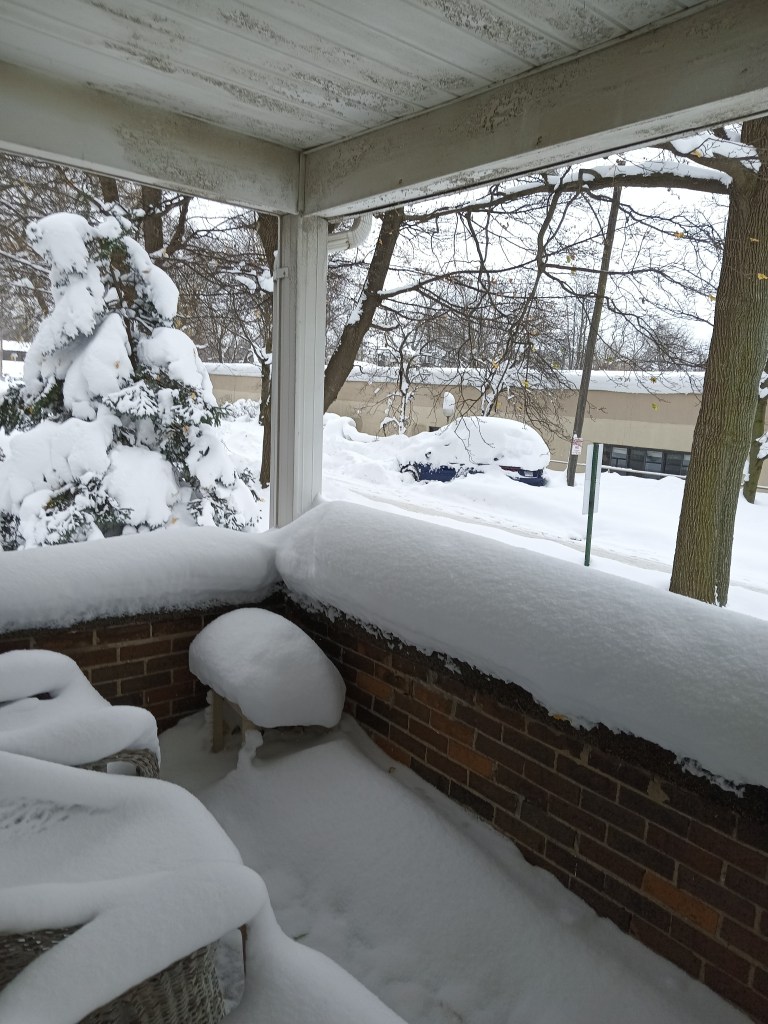
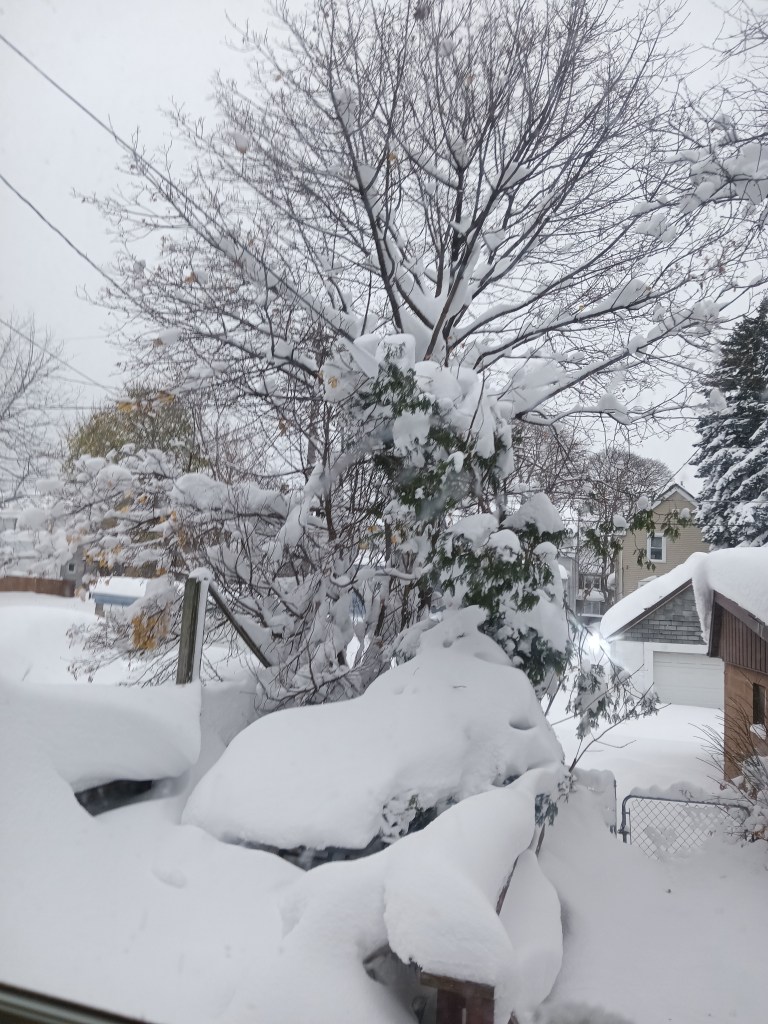
Fifteen minutes before my shift ended Lou found a friend to take us home. My boss let me go early. He drove us to the end of our road, but the snow was so deep that cars were stuck in the road. We had to walk up a block to our home wile snow pounded us in the face. We only had the back door key, but our neighbor had the sidewalk to the front shoveled. We live in a row house, which is like a condominium. One side we are attached to a block of row houses, and on the other we have a small fenced in yard. On the other side of the fences was a long row of more houses. The yard was too deep to walk through and the alley where we usually park our cars was unplowed. Our neighbor let me walk through their house to the back. I waded through snow past my knees to our driveway. I pulled the gate to our fence, opened it a little, and squeezed through. I waded through more snow until I got on our deck and into the house. I let Lou in the front door.

Our front porch.

The next two days I was off work. I didn’t leave the house on Saturday and on Sunday my neighbor took me to the store to get a few things. The snow continued to pile up. I binged on Netflix, worked on workbooks for One Life Project, texted with my friends, and watched Christmas movies with my husband. We watched the news to find that they declared a snow emergency for Erie and called in the National Guard. People were stranded on the major highways and warming centers were being put in place.

Monday it stopped snowing during the day, but the roads were bad. Buses were canceled so I called off work. I had no way of getting there. My dad traveled from Ripley NY, a half hour away for his treatment at the cancer center. Afterwards he tried to get our vehicle started with no luck. My parents took us back to Ripley with them and my dad lent us his pickup. It was nice to have a vehicle to drive, but since I’m short, getting into my dad’s pickup was like climbing a mountain. Getting out I had to slide off the edge of the seat until I reached the ground.

The next day my dad had our vehicle towed. On Wednesday he told us to bring our spare key fob because the one we were using was causing our car problems. That night we drove our car home. The next day when we tried to start it, it wouldn’t start again. We tried to go back in the house, but I had accidentally locked us out. I had a spare key for the back door. So once again, we went through our neighbor’s house to the back of the house. This time the snow was waist deep, and we had to use our neighbor’s shovel to remove snow from around the gate in order for me to squeeze through. I got in the house and let my husband in the front door. We called my dad and spent the rest of the day at home.

Our back yard and porch that I had to wade through

The next morning my parents came so my dad could check the battery in our car. The battery was dead. My dad dropped me off at work and went and got a battery. When my husband showed up for my break, I knew our SUV was running again.

For that whole week it snowed each night, adding to the snow total and back roads became narrower and narrower. The snowplows ran tirelessly, but there was no place to put the snow. By Tuesday the following week customers were starting to dig themselves out and were filling the aisles of the grocery stores. By Friday the news said we had a little over four feet of snow.

I could have gotten down and depressed with our situation, but instead I kept myself busy. I was stressed and frustrated with our car problems, but my dad, our hero, came to our rescue. We were in a bad situation, but as my friend Amy always says, “God will provide,” and he did. Each time I started to worry I texted a friend or found something to do. I kind of liked my two days off from work and away from reality. We were nice and warm in our home.

If you are feeling trapped by the winter weather and dealing with problems you can’t control, turn to your support system, find things to keep you busy, pamper yourself, and find ways to relax. Life throws us in a snowbank sometimes, and it’s up to us to dig ourselves out and to cope.

Next week they are predicting warmer temperatures and rain. We might be swimming our way around Erie. I stayed strong through our drama and because of that I am dancing in the light of recovery.

BEING THANKFUL

The holidays are supposed to be a happy time of year. Thanksgiving is getting closer and closer. People are busy planning big meals to celebrate with friends and family. It’s a time of sharing and being grateful for the things we have in our lives. But for many this holiday and other holidays are dreaded. Some struggle with anxiety about spending time with large groups of people, some are alone, some are struggling with depression and can’t find joy, some dread family drama, and some are spending the holidays without a loved one.

When I was younger, I hated holidays. They only made me feel more alone and depressed. I struggled with friends coming in and out of my life. My classmates and teachers put me down. I felt even more isolated from the world during the holidays. Thanksgiving left me feeling like there was nothing in my life to be thankful for. I fell into a depression and became irritable at the holidays. I fought with my siblings and easily went off on my parents.

When I met my husband, my perspective on holidays changed. He made everything brighter. He gave me reasons to celebrate, and with him I never feel or felt alone. I found things to be thankful for at Thanksgiving time.

This holiday season my husband and I are struggling financially, and I’m helping him search for a job. I feel stressed, sad, and overwhelmed. Thanksgiving is Thursday, and I have been wondering what I have to be thankful for. My husband is out of work, bills are adding up, we’re applying for jobs for him, but no one is calling, we have big decisions to make, and I don’t know how to make them. I feel depression tugging at me, but I’m fighting it.

To get into the holiday spirit I decided to write a list of things I’m thankful for. Here is my list:

  • I’m thankful for friends who have helped my husband and me in our time of need. A customer who has become a friend sent me a check, a friend brought us dog food and a gift card, and another friend gave us a turkey breast.
  • I’m thankful to have a house to live in. Despite how tough things are for us, we still have a roof over our heads.
  • I’m thankful for my husband. I wouldn’t want to go through these tough times with anyone else.
  • I’m thankful for my parents. My parents are always giving moral support, listening to us, and helping us out in anyway they can. Their love is endless.
  • I’m thankful for the food bank at our church. Without the food bank, we would not have food.
  • I’m thankful for my dog, Esther. She always seems to know when I’m struggling, and she gives me extra cuddles.
  • I’m thankful for being strong enough to fight depression. I could easily fall to the bottom of my hole of darkness, but I refuse to let that happen.
  • I’m thankful for having a family that loves me. My parents are wonderful, and so are my siblings. They show me in different ways how much they care.
  • I’m thankful for my job. Without my job, we would be in even worse shape. Talking to my customers brightens my day.

Thanksgiving is a time to look at your life and see what you have to be grateful for. When you are struggling with hard times and mental illness, it’s hard to find good things. If you think about it and list things you are thankful for, you might find light in your soul. You can be grateful for small things like getting out of bed, taking a shower, or going for a walk. No matter how bad things seem, there is always something in your life to be thankful for.

This holiday season I have been struggling with a lot of emotions and coping to keep above the hole, but writing a list of what I am thankful for is helping me celebrate in the light of recovery.